
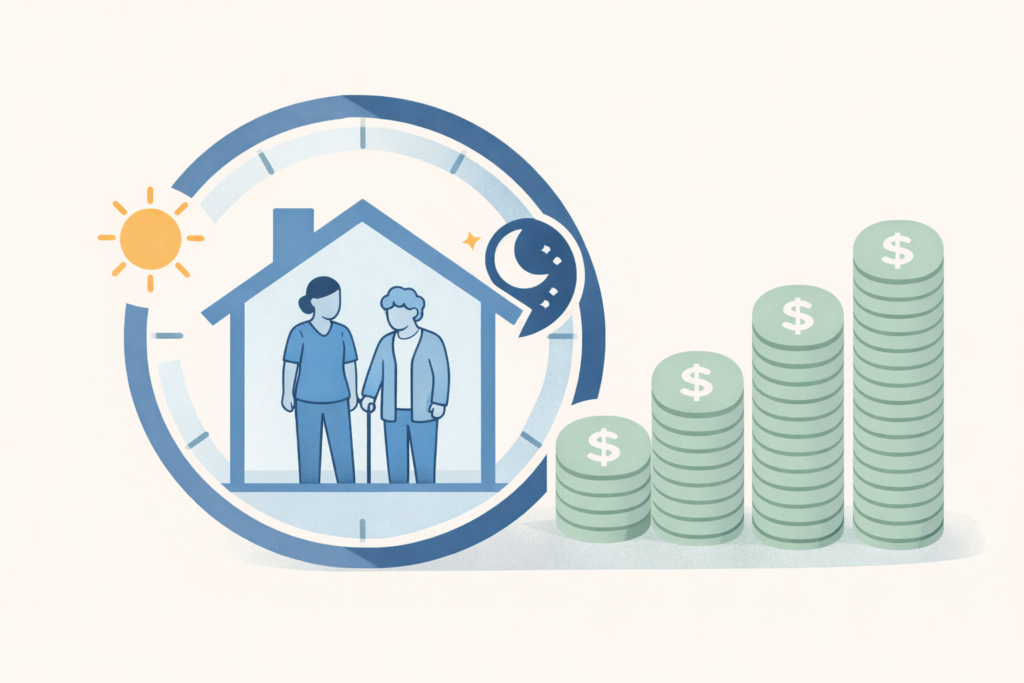
Families rarely start by planning for 24-hour in-home care. Most begin with part-time help—then gradually increase hours as care needs change. At some point, the question becomes unavoidable:
How much does round-the-clock care at home actually cost per month—and is it sustainable?
This article explains typical 24-hour in-home care costs, what drives price differences, and why families often reassess long-term plans once care becomes continuous.
What “24-Hour In-Home Care” Really Means
24-hour care usually involves continuous supervision and assistance, not a single caregiver working nonstop.
Most arrangements include:
- Multiple caregivers rotating shifts
- Coverage during daytime, overnight, and early morning hours
- Ongoing assistance with daily activities and safety monitoring
Because staffing is continuous, costs rise quickly compared to part-time care.
Typical Monthly Cost of 24-Hour In-Home Care
Based on nationwide median hourly rates reported by major cost-of-care surveys, 24-hour in-home care often falls into the following range:
- Hourly rate (non-medical home care via agencies): ~$33–$34/hour (national median benchmarks)
- Estimated monthly cost for 24-hour rotating-shift care: often ~$22,000–$26,000+ per month, depending on regional labor costs and whether care is provided through full agency coverage or blended arrangements (such as partial live-in support combined with hourly shifts).
In practice, agency-based 24-hour coverage is frequently closer to the upper end of estimates because nights, weekends, and staffing requirements add premiums. This range reflects agency-provided care and assumes rotating caregivers rather than a single live-in aide. Actual costs vary depending on location, scheduling model, and care intensity.
Why 24-Hour Care Costs Increase So Quickly
Several factors compound once care becomes continuous:
1. Staffing Requirements
Providing 24-hour coverage typically requires at least two to three caregivers, depending on shift length and labor rules.
2. Overtime and Premium Hours
Evening, overnight, weekend, and holiday shifts may carry higher rates.
3. Agency Overhead
Agency-provided care includes scheduling, supervision, background checks, and backup coverage—adding to total cost.
4. Care Complexity
Hands-on personal care, mobility assistance, or dementia-related supervision may increase hourly rates.
Weekly vs Monthly Cost Examples
Using the national median $34/hour as a baseline:
- 24 hours/day × 7 days/week ≈ $5,700/week
- $5,700/week × 4.33 weeks/month ≈ ~$24,700/month
Even modest variations in hourly rates or staffing can shift monthly costs significantly.
These estimates do not include potential minimum shift requirements or specialized care needs.
How 24-Hour Care Compares to Other Care Options
At lower care levels, in-home care often costs less than residential settings.
However, once care reaches most hours of the day, the comparison changes:
- Assisted living often provides housing, meals, and supervision at a more predictable monthly rate
- In-home care offers familiarity and flexibility but becomes increasingly expensive as hours expand
This is why many families begin comparing care settings once 24-hour care is needed.
Payment Considerations for 24-Hour Care
Most families pay for 24-hour in-home care through private pay, which may include:
- Out-of-pocket payments
- Family cost sharing
- Long-term care insurance benefits (when available)
Medicaid coverage for continuous in-home care is limited and varies by state. Approval often involves waitlists, capped hours, or program restrictions.
Understanding payment options early helps families avoid abrupt transitions later.
When 24-Hour In-Home Care May No Longer Be Sustainable
Families often reassess when:
- Monthly costs rival or exceed other care settings
- Care coordination becomes physically or emotionally overwhelming
- Safety concerns increase despite continuous coverage
- Long-term affordability becomes uncertain
At this stage, the decision is less about preference and more about feasibility over time.
A Practical Perspective
24-hour in-home care can be a valuable option for families prioritizing familiarity and individualized support.
However, its cost structure makes long-term planning essential. Understanding realistic monthly expenses allows families to evaluate options before financial pressure limits choices.
How This Fits Into the Overall Care Picture
- What Is In-Home Care? explains scope and limitations
- In-Home Care Costs outlines typical pricing models
- Who Pays for In-Home Care? explains payment sources
- Medicaid vs Private Pay clarifies coverage differences
- In-Home Care vs Assisted Living compares long-term paths
Together, these resources help families move from short-term solutions toward sustainable care planning.