
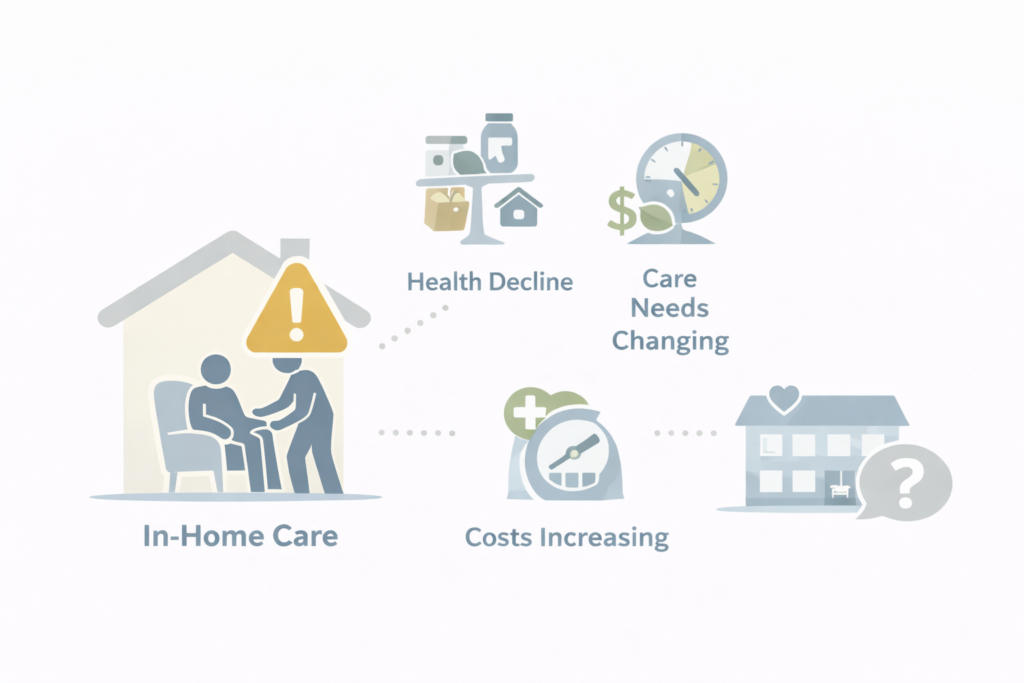
Families rarely plan to “move on” from in-home care.
More often, the question emerges gradually — usually after small adjustments stop solving bigger problems:
How much longer can care realistically remain at home?
This guide focuses on the practical signs that in-home care may no longer be enough, and how families typically recognize when it’s time to reassess care options — before a crisis forces the decision.
Why In-Home Care Often Starts as the Right Choice
In-home care is often the preferred starting point because it allows families to:
- Maintain familiar routines
- Add support gradually
- Retain flexibility over schedules and services
- Preserve independence for as long as possible
For many situations, this approach works well — until care needs begin to change faster than support can reasonably be added.
The Difference Between “More Help” and “More Supervision”
One of the most common turning points isn’t about how much help is needed —
it’s about how much supervision becomes necessary.
In-home care is effective when assistance is needed at specific times of day.
However, families often begin to reassess when:
- Safety concerns arise during unsupervised hours
- Care is needed unpredictably
- Someone must be “on alert” most of the day
At that point, adding more hours doesn’t always solve the underlying issue.
When Costs Start to Change the Conversation
Early on, in-home care may feel manageable because families pay only for the hours used.
Over time, costs often rise as:
- Care hours increase
- Overnight or weekend coverage becomes necessary
- Multiple caregivers are required to cover schedules
For many families, the financial comparison shifts when care extends into most of the day, as hourly in-home care costs accumulate over time.
At this stage, the question becomes less about monthly totals — and more about sustainability.
Safety Is Often the Real Tipping Point
Most families don’t change care settings because of cost alone.
They change because risk increases faster than support can realistically be added at home.
Common warning signs include:
- Falls or near-falls
- Nighttime wandering or confusion
- Difficulty with transfers or mobility
- Caregivers becoming physically or emotionally exhausted
Before making major changes, families often try basic home safety adjustments — such as mobility aids or bathroom modifications — to stabilize the situation.
These steps can help temporarily, but they rarely replace consistent supervision when safety risks become constant.
When In-Home Care May No Longer Be Enough
Families often begin reconsidering care arrangements when:
- Care is needed most hours of the day
- Safety concerns occur outside scheduled care times
- Managing care at home becomes emotionally or physically overwhelming
- The home environment can no longer be adapted effectively
At this point, decisions tend to shift from preference-based to feasibility-based.
Understanding how in-home care is typically paid for can also help families assess long-term sustainability.
How Families Typically Transition
Few families move directly from independence to assisted living.
A more common progression looks like:
- Independent living with occasional help
- Part-time in-home care
- Expanded care hours and home modifications
- Re-evaluation when care demands exceed what can be managed at home
- Transition to assisted living or another structured care setting
Recognizing this progression early allows families to plan — rather than react under pressure.
There Is No “Right” Time — Only Earlier and Later
There is no universal moment when in-home care becomes “not enough.”
However, families who reassess earlier often:
- Have more options
- Feel less rushed
- Experience fewer regrets
The decision isn’t about choosing comfort over care, or independence over safety.
It’s about recognizing when flexibility turns into strain — and when structure becomes support.
Next Steps
- Review whether current care arrangements remain sustainable long-term
- Identify safety risks that cannot be addressed through scheduling alone
- Compare care options based on daily supervision needs — not just cost
For families weighing long-term decisions, understanding how in-home care compares to assisted living can provide additional clarity.