
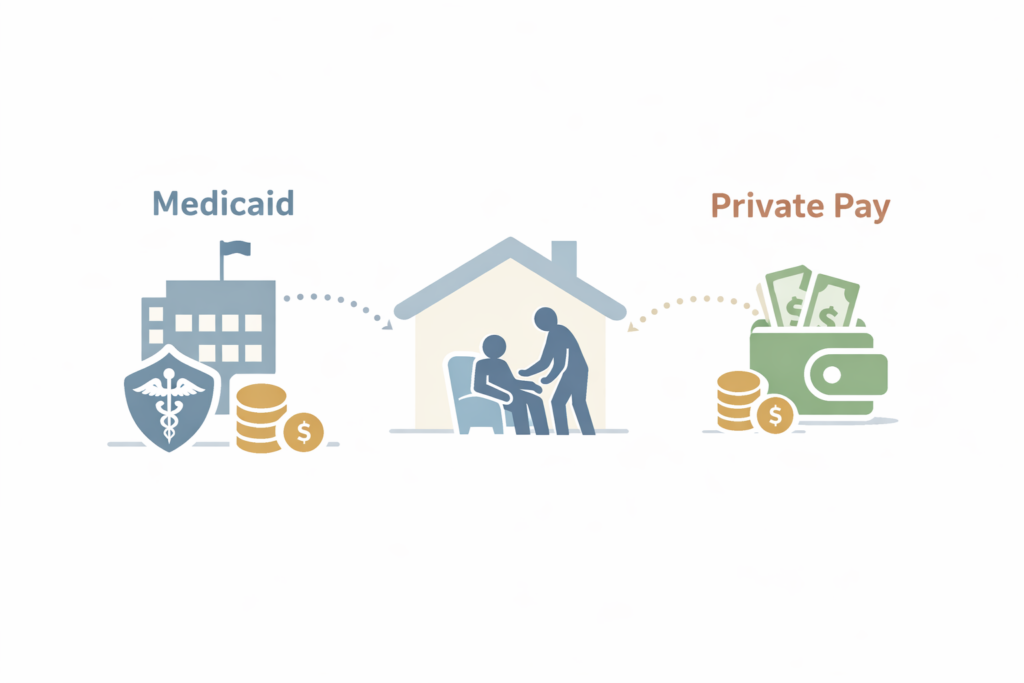
When families begin exploring in-home care, one of the most common assumptions is that insurance or government programs will cover most of the cost. In reality, payment for in-home care in the United States often comes down to a clear divide: Medicaid eligibility versus private pay. This article explains how Medicaid and private pay differ, what each option realistically covers, and why many families transition between the two over time.
Why Payment Structure Matters Early
In-home care is typically non-medical and ongoing, which places it outside the coverage most people expect from health insurance.
That distinction affects:
- How long care can be sustained at home
- How quickly costs escalate
- When families begin reconsidering long-term plans
Understanding whether care will be funded by Medicaid or private pay helps families plan before financial pressure forces rushed decisions.
What “Private Pay” Means for In-Home Care
Private pay refers to paying for care without relying on Medicaid assistance.
This can include:
- Out-of-pocket payments to home care agencies
- Direct payment to independent caregivers
- Shared family contributions
- Long-term care insurance benefits (when available)
Private pay offers maximum flexibility, allowing families to adjust schedules, caregivers, and services as needs change. However, that flexibility comes with increasing financial responsibility as care hours grow.
How Medicaid Covers In-Home Care
Medicaid can help pay for in-home care only under specific conditions, and coverage varies significantly by state.
What Medicaid May Cover
Depending on state programs, Medicaid may support:
- Personal care assistance
- Help with daily activities (bathing, dressing, meals)
- Limited homemaker services
- Care provided through approved agencies or waiver programs
These services are typically delivered through Home and Community-Based Services (HCBS) waivers or similar state-managed programs.
Key Limitations of Medicaid Coverage
Families often discover Medicaid’s limits after care has already begun.
Common restrictions include:
- Income and asset eligibility requirements
- Waitlists, sometimes lasting months or longer
- Caps on hours or types of services
- Limited caregiver choice
- Program rules that differ widely by state
Because of these limits, Medicaid rarely functions as a full replacement for private pay.
Private Pay vs Medicaid: Practical Differences
| Aspect | Private Pay | Medicaid |
|---|---|---|
| Eligibility | No income limits | Income & asset-based |
| Flexibility | High | Limited by program rules |
| Care Hours | Adjustable | Often capped |
| Waitlists | None | Common |
| Caregiver Choice | Broad | Restricted |
| Speed of Access | Immediate | Often delayed |
For many families, private pay begins first, with Medicaid explored later as care needs and costs increase. These differences explain why many families begin with private pay even when Medicaid may eventually be an option. Medicaid often becomes relevant later—after care needs, finances, and eligibility have changed.
When Families Transition from Private Pay to Medicaid
A transition often happens when:
- Care hours expand significantly
- Monthly costs approach or exceed other care options
- Family finances become strained
- Long-term sustainability becomes uncertain
At this stage, families may apply for Medicaid while still paying privately, bridging the gap during approval or waitlist periods.
How Long-Term Care Insurance Fits In
Some families use long-term care insurance (LTCI) to offset private pay costs.
Coverage depends on:
- Policy benefit limits
- Daily or monthly caps
- Elimination periods
- Approved service types
LTCI can reduce out-of-pocket expenses, but it typically does not eliminate private pay entirely.
Why Medicaid Is Not a Simple Safety Net
Medicaid is often viewed as a fallback option, but in practice it is not an immediate or automatic safety net and requires advance planning.
Without early preparation, families may face:
- Gaps in coverage
- Delays in care
- Reduced service options
- Forced care setting changes
Understanding Medicaid rules before they’re needed allows families to plan more gradually.
A Practical Perspective
For most households, paying for in-home care is not an either–or decision. Instead, families often rely on a combination of payment sources over time, adjusting as care needs, finances, and eligibility change. The earlier families understand how Medicaid and private pay interact, the more options they retain.
How This Fits Into the Overall Care Picture
- What Is In-Home Care? explains care scope and limits
- In-Home Care Costs outlines typical expenses
- Who Pays for In-Home Care? explains payment structures
- In-Home Care vs Assisted Living compares long-term options
Together, these articles help families move from uncertainty toward informed decisions.