
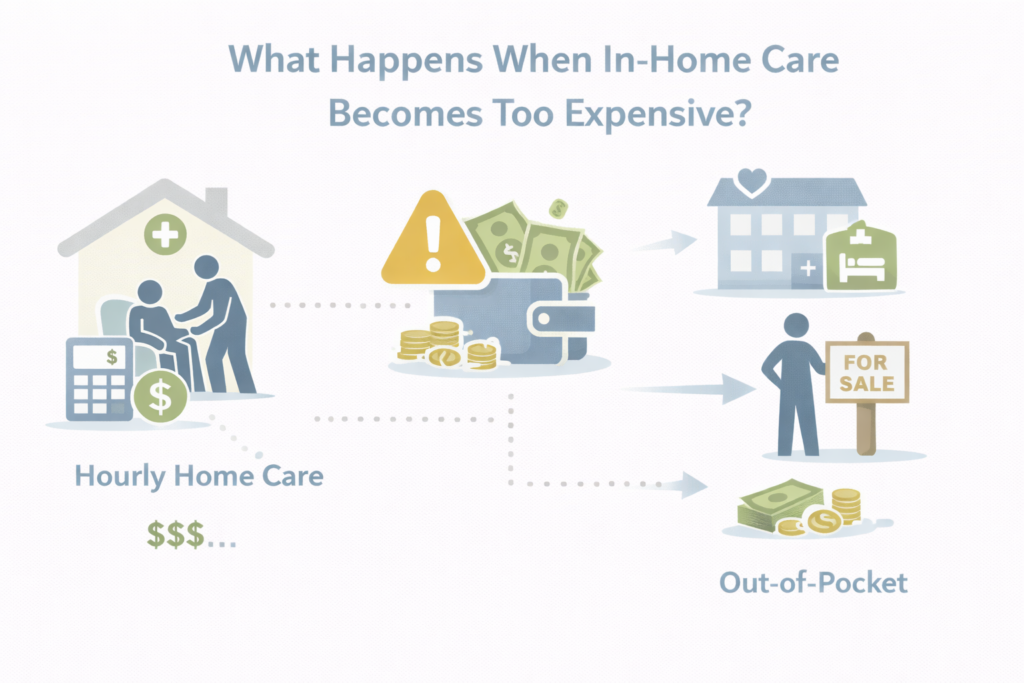
For many families, in-home care starts as a practical solution. It allows an older adult to stay in familiar surroundings while getting the help they need. But over time, a difficult question often emerges:
What happens when in-home care costs rise faster than a family can manage?
This article explains what typically changes when costs escalate, how families recognize the tipping point, and what options realistically remain.
Why In-Home Care Costs Often Rise Gradually — Then Suddenly
In-home care rarely becomes unaffordable overnight.
Costs usually increase in stages:
- A few extra hours are added
- Overnight supervision becomes necessary
- Weekends and holidays require coverage
- Specialized care is introduced
Each change may feel manageable on its own. Together, they can push monthly expenses far beyond what families initially planned for.
Common Signs Costs Are Becoming Unsustainable
Families often recognize financial strain through patterns like these:
- Monthly care costs begin exceeding housing or retirement income
- Family members start filling gaps to avoid adding paid hours
- Care schedules become difficult to coordinate
- Emergency coverage leads to unexpected cost spikes
At this stage, the issue is rarely just money. It’s the growing complexity of maintaining care at home.
Why Cutting Hours Isn’t Always a Solution
When costs rise, families often try to reduce care hours. This works only when care needs are flexible. If safety, supervision, or medical support are required, cutting hours can increase risk. In many cases, reducing paid care simply shifts the burden to family members —
which can become unsustainable emotionally and physically.
Options Families Typically Consider Next
When in-home care becomes too expensive, families usually explore one or more of the following paths. In practice, families rarely choose just one. Most explore these options in stages—often starting with care adjustments before considering a change in setting.
Reassessing the Level of Care
Often the first step is reassessing whether the current care arrangement truly matches the individual’s needs. Some families discover they’re paying for coverage that doesn’t fully match actual needs — or that a different care model could be more efficient. This often leads to comparisons between hourly care, live-in care, and assisted living, rather than eliminating care altogether.
Exploring Assisted Living
For many families, assisted living becomes the next consideration once in-home care costs continue to rise or coordination becomes difficult.
Assisted living may offer:
- More predictable monthly costs
- Built-in supervision
- Reduced need for care coordination
While emotionally difficult, this option can provide greater financial stability when care at home becomes harder to sustain. Families weighing this option often revisit long-term comparisons such as in-home care vs assisted living to understand how costs and support differ over time.
Reviewing Payment Options and Coverage
At this point, funding—not preference—often determines which options remain realistic.
At this stage, families frequently reassess:
- Private pay limits
- Long-term care insurance benefits
- Medicaid eligibility and timing
Why Waiting Too Long Can Limit Choices
One of the hardest realities families face is that waiting until a financial crisis limits options. Availability, pricing, and care quality vary widely by location. Exploring alternatives early allows families to make decisions proactively — rather than under pressure.
A More Helpful Question to Ask
Instead of asking “How do we afford this?”, families often gain clarity by asking:
“What care option can we realistically sustain for the next several years?”
This shifts the focus from short-term fixes to long-term planning.
How This Fits Into the Overall Care Picture
When in-home care becomes financially difficult to sustain, families often benefit from reviewing:
- Hourly Home Care vs Live-In Care to understand whether a different care structure could reduce costs
- In-Home Care Costs to see how pricing typically escalates as care needs increase
- Who Pays for In-Home Care? to clarify funding limits and coverage options
- In-Home Care vs Assisted Living to evaluate when a transition may become more sustainable
Together, these resources help families assess whether adjusting care at home is realistic — or whether planning a transition earlier may preserve more options.