
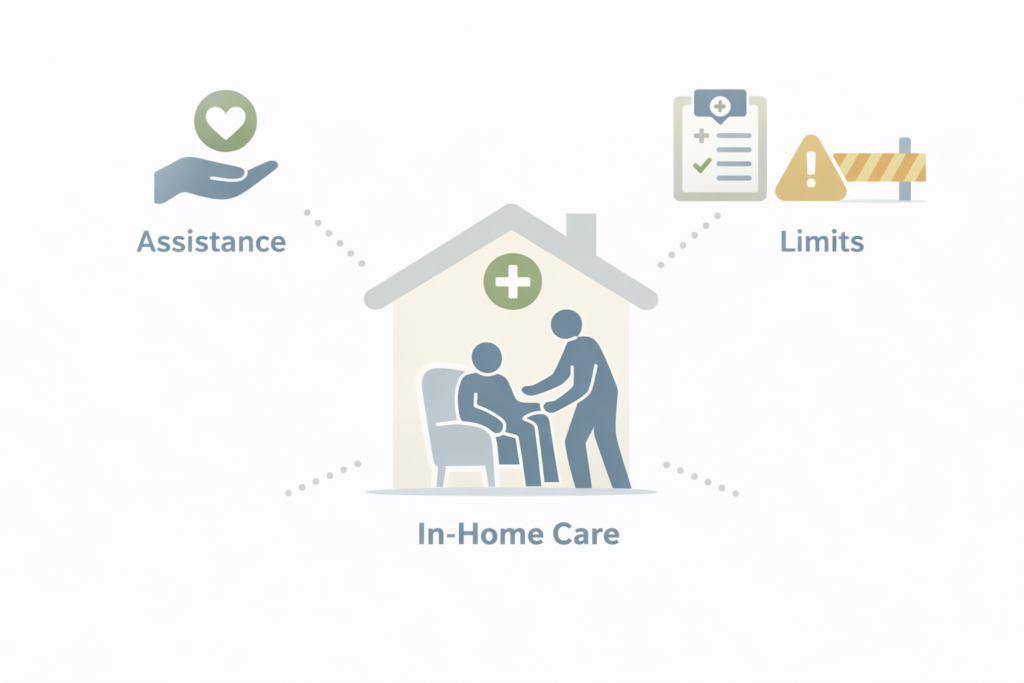
When families begin looking into care for an aging parent, they rarely start with a clear plan.
More often, they start with a feeling — something no longer feels safe, but moving out of the home still feels premature.
In-home care sits in that uncertain middle space.
It can be an effective solution, but only when families clearly understand what it includes, what it does not, and where its limits are.
This article explains in-home care in practical terms — not as a recommendation, but as a way to help families evaluate whether it fits their situation right now.
What In-Home Care Actually Means
In-home care refers to non-medical assistance provided in a person’s own home.
Its purpose is to support daily living, not to deliver medical treatment.
In real caregiving situations, in-home care commonly includes:
- Help with bathing, dressing, and personal hygiene
- Meal preparation and light household tasks
- Medication reminders (not administering or managing medications)
- Companionship and general supervision
- Transportation for errands or appointments
One distinction matters more than any other:
In-home care is not the same as home health care.
Home health care involves medically necessary services such as skilled nursing, physical therapy, or wound care. These services follow different rules, require physician orders, and may be covered under specific insurance programs when eligibility criteria are met.
Confusing these two categories is one of the most common sources of frustration for families early in the process.
Who In-Home Care Is Typically Appropriate For
In-home care is most often used when daily assistance is needed, but continuous medical supervision is not.
In practical terms, families tend to choose in-home care when:
- A parent is physically slowing down but remains cognitively stable
- Balance, mobility, or fatigue has become a concern
- Daily tasks take longer or require assistance, but independence still matters
- A spouse or adult child is providing care and needs relief
This stage is often transitional.
Doing nothing is no longer realistic, but assisted living still feels like too big a step.
For many families, in-home care becomes a way to stabilize daily life while buying time to evaluate longer-term options.
Common Assumptions That Create Problems Later
Many families begin in-home care with expectations that don’t hold up over time.
“Insurance will take care of most of it”
Coverage for non-medical daily care is limited and varies widely depending on the program, eligibility, and location. Families are often surprised to learn how much responsibility remains with them.
This misunderstanding is common when families assume that aging-related help functions like medical treatment.
“It will always be cheaper than assisted living”
In-home care can be manageable at lower weekly hours. However, costs generally increase as care needs expand.
Once care extends into most of the day — or requires overnight supervision — other care options may become more practical, even if they feel more disruptive at first.
“We’ll know when it’s time to change”
In reality, families often realize too late.
Waiting until safety becomes an emergency reduces flexibility and forces decisions under pressure.
These assumptions usually come from a lack of clear explanations early on — not from poor planning.
How Families Usually Start (and Adjust) In-Home Care
Very few families begin with full-time care.
A more typical progression looks like this:
- Limited weekly visits for companionship or basic assistance
- Regular daily support with meals, hygiene, or supervision
- Extended hours as mobility or cognitive needs change
This flexibility is one of in-home care’s strengths.
It is also the reason care plans should be revisited regularly rather than assumed to be permanent.
What works at the beginning often needs adjustment within months, not years.
Safety Often Matters Before More Care Hours
Before increasing care time, many families overlook a simpler step: making the home safer.
In everyday caregiving situations, small adjustments can significantly reduce risk:
- Support rails to assist with getting in and out of bed
- Non-slip surfaces in bathrooms
- Improved lighting for nighttime movement
- Seating or transfer aids that reduce strain on both the senior and the caregiver
These measures do not replace care.
However, they can stabilize a situation, reduce fall risk, and delay the need for additional hours — especially in the early stages of aging in place.
(This is often where practical home safety equipment becomes part of a broader care strategy.)
When In-Home Care May No Longer Be the Right Fit
In-home care has limits.
Families often begin to consider other options when:
- Supervision is needed throughout the day and night
- Memory or safety risks increase significantly
- Care coordination becomes too complex to manage at home
- The emotional or physical toll on caregivers becomes unsustainable
Recognizing these signals early allows families to explore alternatives calmly, rather than reacting during a crisis.
How In-Home Care Compares to Other Care Options
In-home care is one part of a broader care landscape.
Families commonly evaluate it alongside:
- Assisted living, which provides structured daily support and predictability
- Home health care, which addresses medical needs under specific eligibility requirements
- Skilled nursing, which offers continuous medical supervision
Each option exists for a different reason.
The right choice depends less on labels and more on the kind of help that is actually needed day to day.
Questions Families Commonly Ask
Is in-home care the same as hiring a caregiver?
In many cases, yes. Training, oversight, and scope of services can vary depending on the provider and state regulations.
How many hours do families usually start with?
Many begin with limited weekly hours and adjust as needs change.
Does Medicare cover in-home care?
Medicare may cover certain home health services when eligibility requirements are met. It generally does not cover long-term, non-medical daily care.
Is it safe for seniors living alone?
It can be, depending on mobility, cognition, home setup, and the level of support in place.
A Practical Perspective
In-home care is not just a service — it is a care strategy.
It works best when families:
- Understand its scope and limits
- Reassess needs regularly
- Plan for change before safety becomes an emergency
The most important question is not which care option sounds best.
It is what level of help is actually needed right now — and how that need may change over time.
Next Steps
- Compare in-home care and assisted living in practical terms
- Understand which costs and coverage programs typically apply
- Explore simple home safety measures that support aging in place