
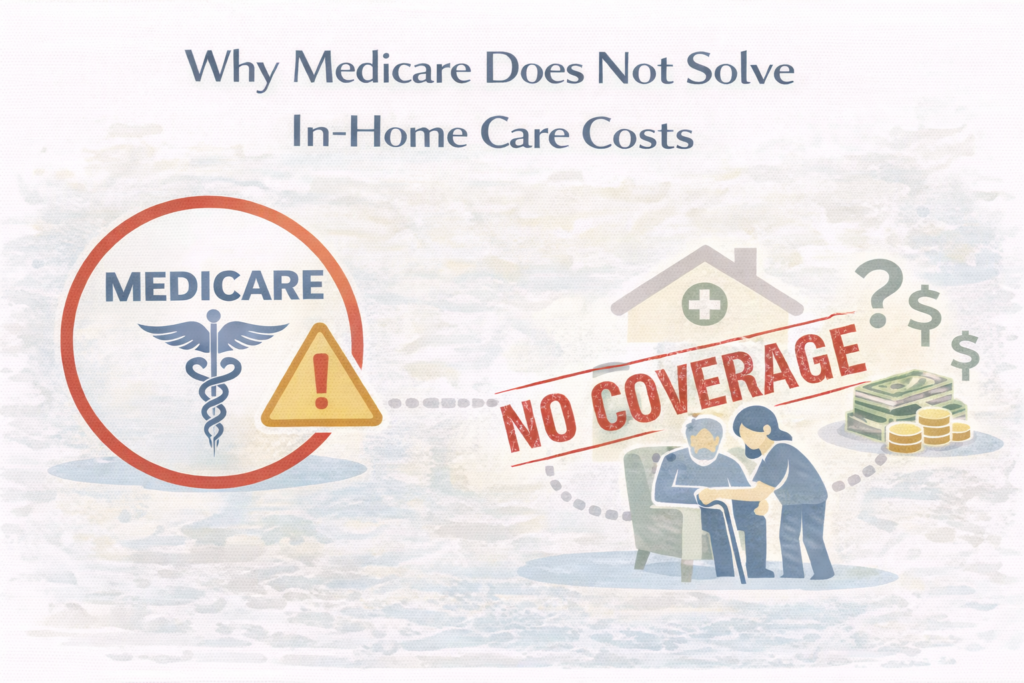
Many families assume that Medicare will help pay for in-home care. After all, Medicare is the primary health insurance for older adults, and care at home sounds like a medical need.
In reality, Medicare does not solve the long-term cost of in-home care. It can help in limited situations, but it is not designed to cover ongoing daily assistance.
This article explains what Medicare actually pays for, why it does not cover most in-home care, and why families often misunderstand its role.
Why Medicare Feels Like It Should Cover Home Care
In-home care usually begins with help for daily activities such as bathing, dressing, and meal preparation. These needs feel health-related, especially when someone is recovering from illness or managing chronic conditions.
Families often expect Medicare to step in because:
Care happens at home
A doctor may be involved
The person is older or recently hospitalized
Medical equipment or therapy may be present
However, Medicare is structured around short-term medical treatment, not long-term daily support.
What Medicare Actually Covers at Home
Medicare can pay for certain home-based services, but only under strict conditions. Coverage usually applies when care is medically necessary and ordered by a physician.
Medicare may cover:
Skilled nursing visits
Physical, occupational, or speech therapy
Limited home health aide services related to medical care
Medical supplies or equipment
These services are typically short-term and tied to recovery or treatment goals. They do not include ongoing help with bathing, meals, or supervision once medical improvement is no longer expected.
Why This Does Not Match Typical In-Home Care Needs
Most families seek in-home care for non-medical reasons: help with daily activities, safety monitoring, and companionship. These services are usually billed by the hour and continue as long as needs remain.
National median agency rates for non-medical in-home care are around $34 per hour. At that rate, part-time care at 20 hours per week costs about $2,900 per month, and full-time daytime care at 40 hours per week costs roughly $5,900 per month. These benchmarks are outlined in In-Home Care Costs in 2026.
Medicare does not pay for this type of ongoing assistance. As a result, families must rely on savings, retirement income, or other payment sources for most in-home care needs.
The Common Point of Confusion
The misunderstanding often comes from mixing up medical care with personal care.
Medicare focuses on:
Treatment
Recovery
Clinical services
In-home care focuses on:
Daily functioning
Safety
Supervision
Quality of life
Once skilled treatment ends, Medicare coverage usually ends as well. What remains is the need for personal assistance, which Medicare does not consider a medical benefit.
How Medicare Differs From Medicaid
Medicare and Medicaid are often confused because both are government programs. They serve very different roles in long-term care.
Medicare is based on age or disability and covers medical services. Medicaid is based on income and assets and can help pay for non-medical in-home care in some states.
This distinction is explained in Medicaid vs Private Pay for In-Home Care, where coverage depends on eligibility and state program rules rather than medical necessity alone.
For families who do not qualify for Medicaid, the remaining option is usually private pay.
Why Medicare Does Not Change the Long-Term Math
Medicare may help briefly after a hospital stay or during a recovery period, but it does not change the underlying cost structure of in-home care.
Once care becomes ongoing rather than temporary:
Hourly costs remain
Care hours often increase
Out-of-pocket spending grows
Families must plan for sustainability
This pattern is closely tied to private pay home care, where affordability depends on how long care needs remain stable.
Medicare does not prevent this progression. It only affects short-term medical episodes.
A More Realistic Planning Frame
Instead of asking, “Will Medicare pay for this?”, families often gain clarity by asking, “What part of this care is medical, and what part is daily support?”
This distinction helps set realistic expectations:
Medical treatment may be covered
Daily assistance is usually not
Long-term costs still need a plan
Understanding this early prevents families from delaying financial planning based on assumptions about coverage.
How This Fits Into the Larger Care Picture
Medicare plays an important role in treating illness and supporting recovery at home. It does not replace the need for long-term care planning.
When families look at in-home care costs, insurance benefits, and public programs together, a clearer picture emerges. Medicare affects short-term episodes. Medicaid and private pay shape long-term affordability.
Seeing these roles separately helps families plan transitions before financial pressure forces rushed decisions.
The Bottom Line
Medicare can help with short-term medical care at home. It does not pay for most long-term in-home care needs such as bathing, meals, or supervision.
Families who assume Medicare will solve in-home care costs often delay planning until savings are already being used. Understanding Medicare’s limits early allows families to make realistic decisions about how care will be funded and how long current arrangements can last.