
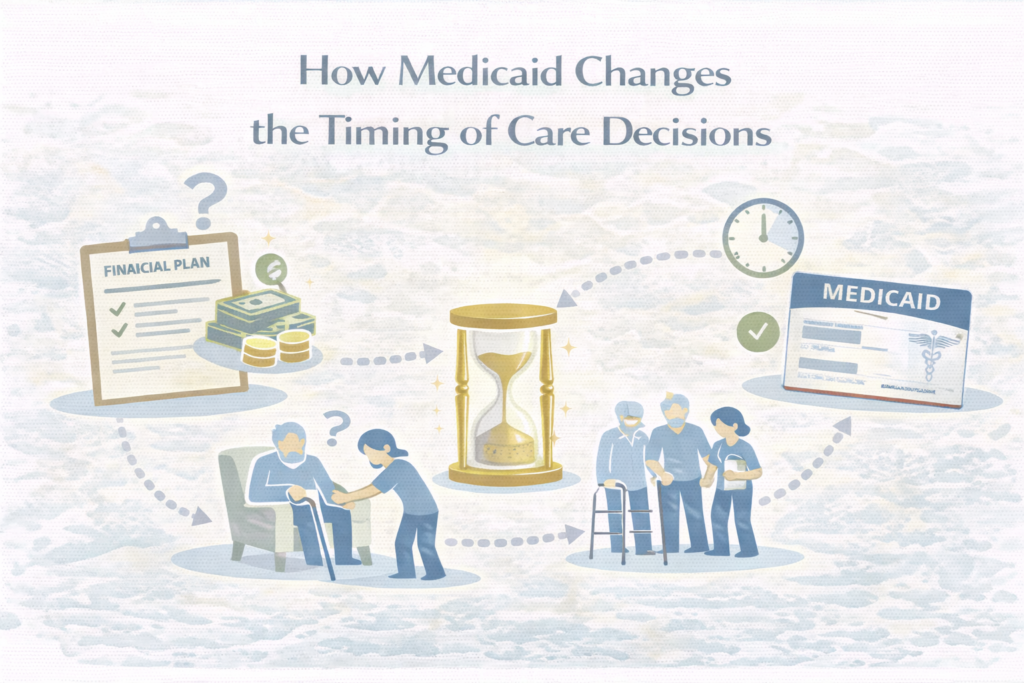
When families plan for in-home care, the first question is usually about cost. The second question, often later, is about how long that cost can be sustained. Eventually, a different factor begins to shape the decision more than preference or convenience: Medicaid eligibility.
This article explains how Medicaid changes the timing of care decisions, why families often shift plans around it, and how financial structure can matter more than personal choice in long-term care.
Why Cost Drives the Timeline of Care
Most in-home care in the United States is paid for privately. National median rates for non-medical home care are around the low-to-mid $30s per hour. At those rates, part-time care can cost several thousand dollars per month, and higher-hour care can approach or exceed the cost of assisted living. These benchmarks are outlined in In-Home Care Costs in 2026.
Early on, families usually focus on whether they can afford care now. Over time, the more important question becomes how long they can afford it. As care hours increase and needs become continuous rather than task-based, affordability becomes a timeline problem, not just a monthly budget issue.
What Medicaid Changes in That Timeline
Medicaid introduces a different structure. Instead of asking how long private funds will last, families begin asking when eligibility might begin. Unlike private pay, Medicaid is based on income and asset limits rather than care hours alone.
Medicaid can help pay for certain in-home care services through state-run programs, often called Home and Community-Based Services (HCBS) waivers. Coverage and rules vary by state, but Medicaid may support personal care, help with daily activities, and limited homemaker services. These differences are explained in Medicaid vs Private Pay for In-Home Care.
Once Medicaid becomes part of the picture, the decision is no longer only about what level of care is preferred. It becomes about what level of care fits within program rules, waitlists, and eligibility thresholds.
Why Eligibility Often Matters More Than Preference
Families usually prefer to keep care at home as long as possible. In-home care offers familiarity and flexibility. However, Medicaid programs often limit the number of hours or types of services covered. They may also restrict which providers can be used.
As a result, families sometimes reach a point where private pay is no longer sustainable, but Medicaid-based in-home care is not yet available or not sufficient to meet full-day needs. This gap forces a shift in planning.
Instead of choosing between care settings based on comfort or routine, families begin choosing based on what Medicaid will support. At this stage, assisted living or other residential options may become more realistic if they offer a clearer funding pathway.
How Private Pay Fits Before Medicaid
For many households, private pay functions as a bridge. Families start with savings, income, or long-term care insurance benefits. Over time, those resources may decline as care needs rise.
This progression is described in Private Pay Home Care, where affordability depends on how quickly care needs escalate rather than on the initial cost alone.
When families know Medicaid may eventually be needed, the focus shifts to managing the transition rather than avoiding it. Planning becomes less about maintaining the current arrangement indefinitely and more about understanding when and how a different funding structure will take over.
Why Medicaid Often Changes the Setting, Not Just the Payment Source
Medicaid does not simply replace private pay. It reshapes what type of care is realistic.
Common changes include:
Care hours being capped or adjusted
Caregivers being selected from approved providers
Waiting periods before services begin
Rules that differ by state and program
These factors mean that Medicaid does not preserve the same care model families may have been using. Instead, it often introduces a different structure entirely. For some families, that structure fits well. For others, it changes the care setting itself.
This is why Medicaid frequently affects not just how care is paid for, but where and how it is delivered.
A More Realistic Planning Frame
Rather than asking only whether Medicaid will help pay for care, families often gain clarity by asking when Medicaid is likely to become necessary.
This reframes the decision from a single moment into a process:
How long private pay is realistic
When eligibility might occur
What care model fits program limits
Which transitions may be unavoidable
Understanding this timeline allows families to plan earlier rather than reacting during a financial or safety crisis.
How This Fits Into the Overall Care Picture
Medicaid plays a different role from Medicare and private insurance. It does not solve the rising cost of care, but it does define the point at which funding structure changes.
Seen alongside In-Home Care Costs in 2026 and Medicaid vs Private Pay for In-Home Care, Medicaid represents the stage where care decisions become more constrained by policy than by preference.
Families who understand this shift early are better able to make deliberate transitions instead of rushed ones.
The Bottom Line
Medicaid does not simply extend private pay in-home care. It changes the timing and structure of care decisions. Eligibility often becomes more important than personal preference, and program rules shape what level of care is realistic.
For many families, Medicaid marks the point where planning moves from “how long can we afford this” to “what care model fits the system we are entering.” Understanding that shift in advance allows families to retain more control over when and how those decisions are made.