
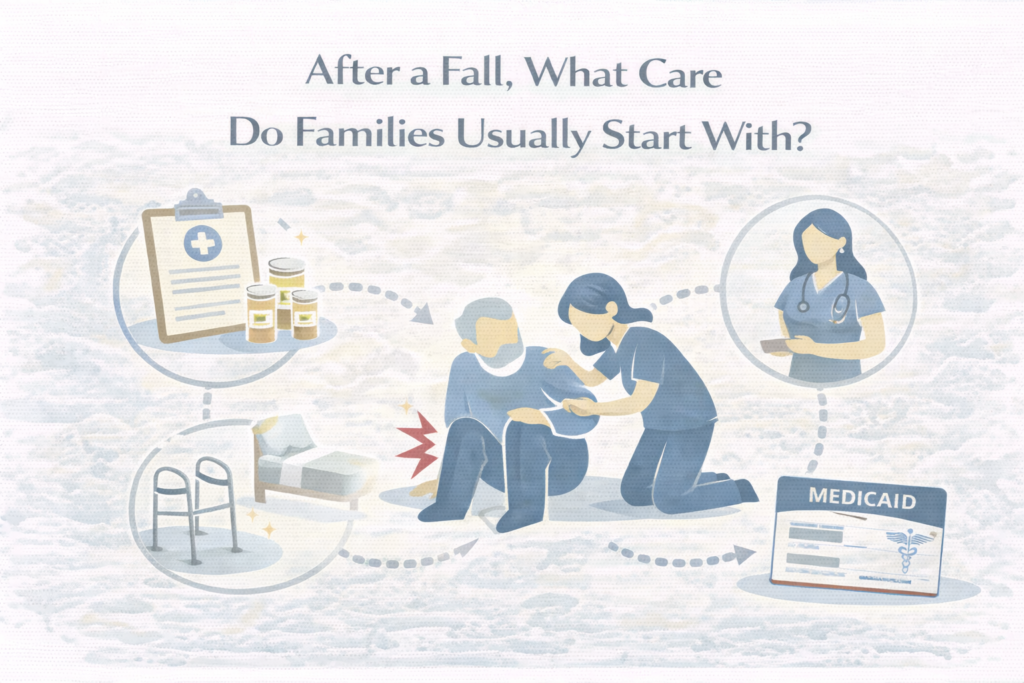
Why a fall changes care decisions
A fall is one of the most common events that suddenly pushes families into care decisions. According to the U.S. Centers for Disease Control and Prevention, about one in four adults age sixty five and older falls each year, and falls are the leading cause of injury related hospital visits in this age group. For many families, the injury itself is not the main issue. What matters more is what changes afterward. Walking feels less safe. Daily tasks become harder. Confidence drops.
The real question becomes what kind of help is needed now.
What families usually do first
Most families do not start with assisted living or nursing care. They start with what they already have.
The first step is usually informal family help. A spouse checks in more often. An adult child visits daily. Someone helps with meals, medications, or bathing. This happens because a fall feels temporary. Families expect recovery. They do not see it yet as a long term care problem.
But recovery is rarely just physical. The National Council on Aging explains that fear of falling often leads to reduced activity, which can weaken muscles and balance. Even when injuries heal, routines often do not return to what they were before.
Why in home care is the most common first paid option
When family help becomes difficult to maintain, many families add part time in home care. This usually means a caregiver coming for a few hours a day or a few days a week to help with bathing, walking, or household tasks.
This is often the first time care becomes a financial decision. Families are not thinking about long term care. They are thinking about support during recovery.
If you are unfamiliar with what in home care actually includes and what it does not, this is where understanding the basics matters. A clear overview of what in home care covers and where its limits are can be found in What Is In-Home Care? When It Helps, What It Includes, and Its Limits.
In home care feels like the least permanent choice. It keeps the person at home. It preserves independence. It buys time.
What happens after hospital discharge
If a fall leads to a hospital stay, care decisions become more urgent. Discharge planners may arrange short term home health services such as physical therapy or nursing visits. These services focus on medical recovery, not daily living.
Families often discover quickly that medical visits alone do not solve everyday problems like getting to the bathroom safely or preparing meals. This is why many families combine home health and non medical home care at first. One addresses the injury. The other addresses daily function.
This stage often marks the transition from temporary help to structured care.
Why families rarely move straight to assisted living
A single fall rarely sends someone directly into assisted living. What matters more is what the fall reveals. Was balance already declining. Is memory affected. Is supervision needed. Research in gerontology shows that repeated falls and loss of daily function are stronger predictors of institutional care than a single injury event.
In practice, families treat the first fall as a warning rather than a final decision.
Assisted living usually enters the conversation when falls happen again or when living alone becomes unsafe.
When the first care step stops working
Right after a fall, families often underestimate how much help will be needed. They assume short term support will be enough. Over time, fear of falling and physical limitations can increase dependence. What started as a few hours of help can turn into daily care.
This is the point where families face a second decision. Do we increase hours. Do we add supervision. Or do we consider a different care setting.
Signs that in home care may no longer be enough are discussed in more detail in When In-Home Care Is No Longer Enough: Signs It May Be Time to Reconsider Care Options.
And when care hours keep rising, the shift from part time help to full time care often changes everything about cost, schedules, and family roles. That transition is explored in What Changes When Care Moves From Part-Time to Full-Time In-Home Care.
The path most families follow
For most families, care after a fall begins at home.
It starts with family help. It often moves to part time in home care. These first steps feel temporary because the goal is recovery, not long term change. A fall looks like a single accident, and families naturally respond as if it will pass.
What matters is not predicting the future, but understanding the present. After a fall, the question is not where care will end, but what kind of help makes daily life safer right now.
Most families do not make long term care decisions on the day of a fall. They make short term choices that fit what they can manage. Home based care is usually the first answer because it keeps life familiar and allows families to adjust gradually.
A fall is rarely the decision itself. It is the moment families realize that daily life now needs more support than before.