
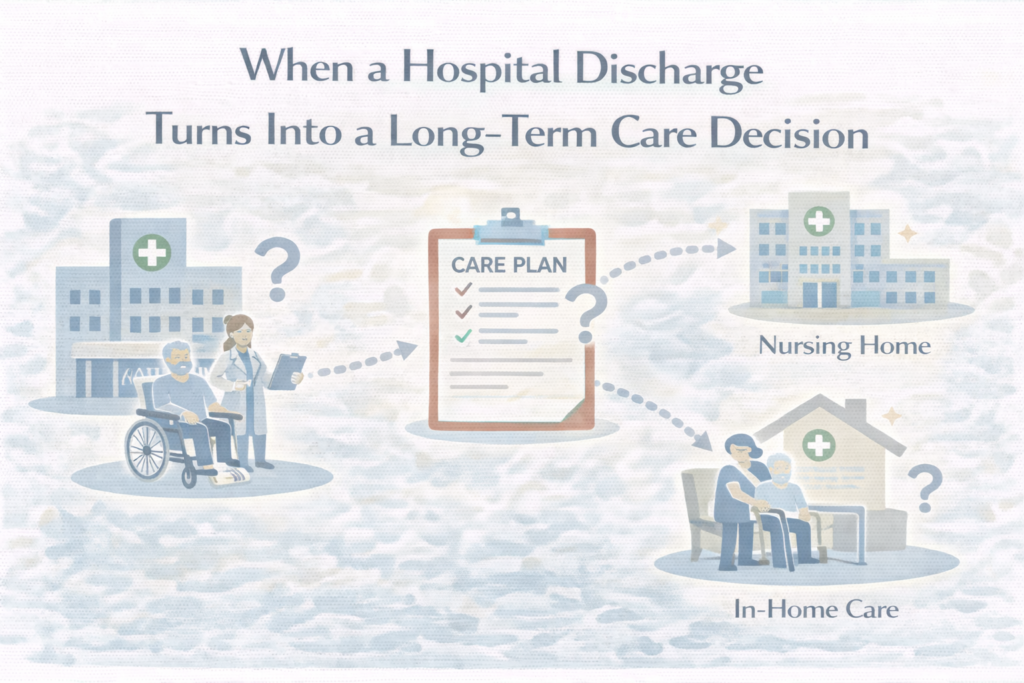
Why discharge feels like the end but becomes the beginning
For many families, the hospital stay feels like the crisis. Once the doctor says discharge is possible, everyone expects relief.
But discharge is often the moment when the real care decision begins.
Inside the hospital, daily risks are controlled. Nurses help with movement. Medications are given on time. Meals appear without effort. At home, those systems disappear overnight. What looked manageable in a hospital bed can feel overwhelming in a living room.
Discharge does not mean life has returned to normal. It means responsibility has shifted to the family.
What families expect after discharge
Most families expect recovery to follow a straight path. The injury improves. Strength returns. Life resumes.
What they often experience is something more complicated.
Walking may improve, but confidence does not. Pain may fade, but fatigue remains. Daily tasks take longer. The person who fell becomes cautious, and caution reduces movement. Less movement weakens muscles. Weak muscles increase fall risk.
This is not a medical failure. It is how aging bodies respond to stress.
The discharge plan usually focuses on medical needs such as physical therapy or nursing visits. Those services are important, but they do not cover bathing, cooking, supervision, or nighttime safety. Families discover quickly that healing and living are not the same thing.
The first care choice families usually make
After discharge, most families do not choose assisted living. They choose to add support at home.
This often looks like a mix of short medical visits and practical help. A therapist comes a few times a week. A caregiver helps with bathing or meals. Family members fill the gaps in between.
This choice feels temporary. It matches the belief that care is part of recovery, not a permanent change. It also preserves the home, which carries emotional meaning. Staying home feels like winning.
For families who are unsure what in home care actually covers and where its limits are, understanding that difference matters early. That distinction is explained in What Is In-Home Care? When It Helps, What It Includes, and Its Limits.
How discharge quietly changes daily life
Discharge reveals what daily life now requires.
Simple routines become decisions. When to shower. How to use the stairs. Whether it is safe to be alone. These questions were invisible before the hospital stay.
Over time, families notice that help is needed more often than expected. What started as a few visits a week grows into daily support. Schedules change. Family members rearrange work hours. Care becomes part of the household structure.
This shift does not happen because the person suddenly worsens. It happens because the home no longer protects them the way the hospital did.
When care hours increase, families often feel the change before they name it. The move from part time help to something closer to full time care is not just about time. It reshapes cost, responsibility, and family roles. That shift is explored in What Changes When Care Moves From Part-Time to Full-Time In-Home Care.
Why families do not treat discharge as a permanent decision
Even when discharge leads to more care, families rarely see it as a final answer.
They view it as a test. Can we manage this way. Can we make the house safer. Can recovery continue.
This mindset delays larger choices. Assisted living feels too big for a moment that still looks like recovery. Families prefer to wait for patterns rather than react to a single event.
Over time, patterns do appear. Repeated falls. Growing supervision needs. Fatigue in caregivers. The question slowly shifts from recovery to sustainability.
When the discharge plan stops fitting real life
Hospital plans are built for medical stability. Families live with practical reality.
When daily life becomes harder instead of easier, stress rises. Caregivers become exhausted. Safety concerns multiply. Nights become the hardest part. At that point, families face a second decision.
Do we add more care at home, or is home no longer the right place.
This is not a sudden failure. It is the result of time revealing what support is truly required.
For families who begin questioning whether staying at home still works, that uncertainty itself is a signal. A structured way to think through that moment appears in Is Staying at Home Still Working? A Practical Decision Checklist for Families.
How discharge leads to long term care without feeling like it
Very few families say, “We are choosing long term care today.”
What they say is, “We just need more help for now.”
Discharge creates the first step. More help creates the second. Time creates the third. By the time the word long term enters the conversation, the path is already shaped.
The hospital stay does not create the need for care. It exposes it. The discharge does not make the decision. It begins the process.
For many families, that process looks gradual. Home care expands. Independence narrows. The home becomes a workplace for care.
Eventually, families begin comparing home care with assisted living, not as an abstract idea but as a response to lived experience. That decision process is described in How Families Choose Between Home Care and Assisted Living.
What discharge really changes
Discharge changes who manages risk.
Inside the hospital, risk belongs to the system. At home, it belongs to the family.
That is why discharge feels small on paper but heavy in life. It transfers responsibility from professionals to people who love the patient. Love makes that responsibility feel possible at first. Time reveals how demanding it is.
A hospital stay ends. A care journey often begins.