
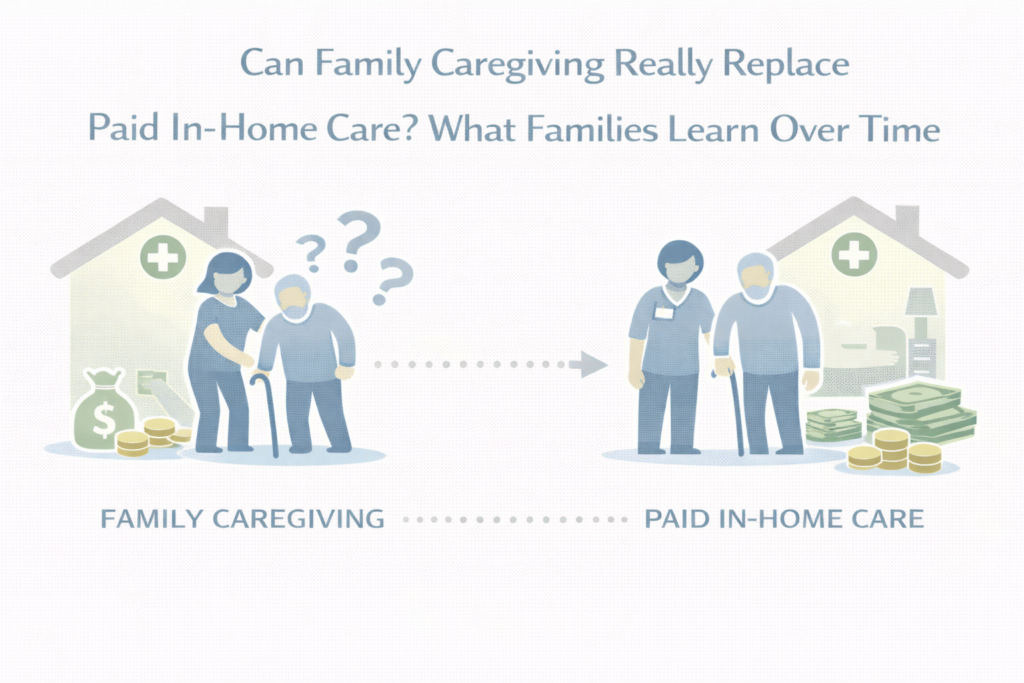
When care needs increase, many families reach a familiar crossroads. Paid in-home care is becoming expensive. Schedules are harder to manage. And someone eventually asks the question that feels both practical and personal:
“Can we just do more ourselves?”
For some families, increased family caregiving does help — for a while. But over time, many discover that family care rarely replaces paid care entirely. Instead, it changes how care is shared, layered, and sustained.
This article looks at what families typically learn after trying to rely more heavily on family caregiving — not in theory, but in practice.
Why Family Caregiving Feels Like the Logical Next Step
Family caregiving often increases gradually, not by design.
It usually starts when:
- Care costs rise faster than expected
- Paid hours are added repeatedly without solving underlying issues
- A spouse or adult child is already “helping a little”
- Families want to avoid another major decision too quickly
At this stage, family care feels flexible, personal, and cost-saving. It can stabilize care temporarily — especially when needs are limited and predictable.
Where Family Caregiving Often Works Well
Family caregiving is most effective when:
- Care needs are task-based, not continuous
- Help is needed at specific times of day
- Safety risks are manageable
- Family members can assist without sacrificing health or income
- Responsibilities are clearly shared
In these situations, family care can meaningfully reduce paid hours and delay more intensive support. Many families successfully combine part-time paid care with family involvement for months — sometimes years.
Where Family Caregiving Begins to Break Down
Problems rarely appear all at once. They surface gradually, as care demands change.
Family caregiving becomes harder to sustain when:
- Supervision is needed outside scheduled care times
- Nights, weekends, or emergencies require coverage
- One family member carries most of the responsibility
- Care becomes emotionally or physically exhausting
- Family schedules begin revolving entirely around caregiving
At this point, caregiving is no longer a supplement. It becomes a substitute — and that shift carries real risk.
The Hidden Cost of Replacing Paid Care With Family Care
The biggest strain families report isn’t always financial. It’s cumulative.
Common consequences include:
- Chronic fatigue and disrupted sleep
- Reduced work hours or job loss
- Increased stress and conflict among siblings
- Health issues for caregivers
- Care decisions made reactively rather than intentionally
When family caregiving replaces paid care rather than supporting it, sustainability becomes fragile — even when intentions are good.
Why Most Families End Up Mixing Care Models
In practice, few families choose between family care or paid care.
Most end up combining:
- Paid in-home care for consistency and supervision
- Family caregiving for flexibility and emotional support
This hybrid approach works best when family care is treated as support, not replacement. Paid care provides structure. Family care fills gaps — without carrying the full weight. Families who attempt to rely solely on family caregiving often revisit paid options once risks, exhaustion, or unpredictability increase.
When It’s Time to Reassess the Balance
Families often reconsider their approach when:
- Paid hours continue to rise despite family involvement
- Care feels increasingly reactive
- Safety concerns occur outside scheduled support
- Caregiving begins to affect family health or stability
At this stage, reassessment isn’t a failure. It’s a necessary part of long-term care planning. Some families explore different in-home care structures. Others begin comparing whether remaining at home is still workable — or whether a different care setting may offer more stability.
A More Realistic Question to Ask
Instead of asking:
“Can family caregiving replace paid care?”
Families often gain more clarity by asking:
“How much responsibility can family caregiving realistically carry — and for how long?”
This reframing shifts the focus from sacrifice to sustainability.
How This Fits Into the Broader Care Decision Path
Families navigating this stage often continue by reviewing:
- When Increasing In-Home Care Hours Stops Solving the Problem
- What Happens When In-Home Care Becomes Too Expensive
- In-Home Care vs Assisted Living: How Families Decide and When a Transition Makes Sense
Together, these resources reflect how care decisions usually unfold — gradually, imperfectly, and with ongoing reassessment.
The Bottom Line
Family caregiving is powerful. It can delay transitions, reduce costs, and provide meaningful support. But for most families, it works best alongside paid care — not instead of it. Understanding where family caregiving helps, and where it quietly becomes unsustainable, allows families to make clearer decisions before pressure takes over.