
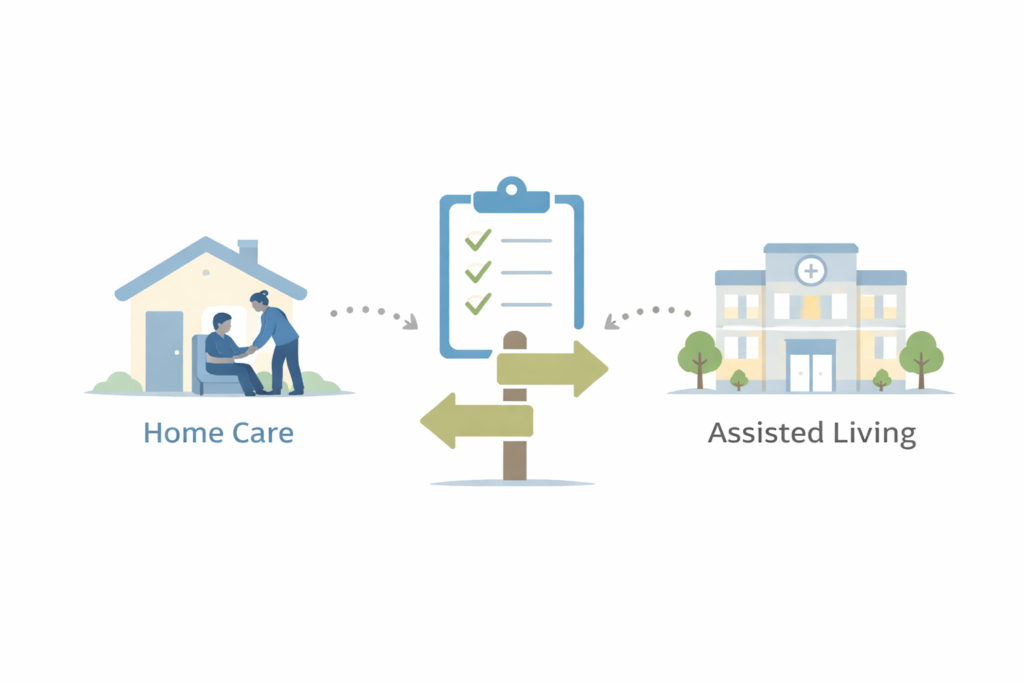
When families compare home care and assisted living, they are rarely choosing between two equally appealing options.
More often, they are trying to answer a harder question:
How long is it realistic to stay at home — and what happens when that stops being true?
This article explains how families typically evaluate the transition between home care and assisted living, focusing on daily needs, safety, cost sustainability, and long-term feasibility.
What Home Care and Assisted Living Are Designed to Do
Although these options are often compared, they solve different problems.
Home care is designed to support daily life at home, adding help gradually as needs change.
Assisted living is designed to provide ongoing supervision and support in a structured environment.
Understanding that distinction helps clarify why the decision often changes over time.
How Families Usually Compare the Two
Most families don’t compare these options all at once.
They move through a sequence of practical questions.
1. Daily Assistance vs. Daily Supervision
Home care works well when help is needed at specific times of day.
Assisted living becomes more relevant when supervision is needed throughout the day — especially when safety concerns arise during unsupervised hours.
2. Cost Over Time, Not Just Monthly Cost
At lower levels of care, home care often appears less expensive because families pay only for the hours used.
However, costs rise quickly when:
- Care hours increase
- Overnight or weekend support becomes necessary
- Multiple caregivers are required
Assisted living costs are typically more predictable month to month, even if the upfront number feels higher.
3. Flexibility vs. Sustainability
Home care offers flexibility early on.
But as care needs grow, that flexibility often shifts responsibility onto family members — coordinating schedules, filling gaps, and responding to emergencies.
Assisted living transfers much of that coordination to the facility itself, which some families find more sustainable over time.
When Safety Becomes the Turning Point
Most families do not transition solely because of cost.
They transition because risk increases faster than support can realistically be added at home.
Common turning points include:
- Falls or near-falls
- Nighttime confusion or wandering
- Difficulty with transfers or mobility
- Caregivers becoming physically or emotionally exhausted
Before increasing care hours, families sometimes explore home safety adjustments, but these steps do not replace supervision when risks become constant.
When Home Care May No Longer Be Enough
Families often begin considering assisted living when:
- Care is needed most hours of the day
- Safety concerns occur outside scheduled care times
- Managing care at home becomes overwhelming
- The home environment can no longer be adapted effectively
At this stage, the decision is less about preference and more about feasibility.
A Practical Perspective
There is no universally “better” choice.
Home care works best when care needs are moderate and manageable.
Assisted living becomes more appropriate when supervision needs increase and home-based solutions are no longer sufficient.
Families who revisit this decision early tend to have more options — and fewer regrets.
How This Fits Into the Overall Care Picture
- What Is In-Home Care? explains scope and limits
- In-Home Care Costs outlines typical expenses
- Who Pays for In-Home Care? explains payment structures
- When In-Home Care Is No Longer Enough highlights transition signals
Together, these pieces help families move from questions to decisions over time.
This article focuses on how families typically decide when to transition between care options.