
Families who decide to keep care at home often face a second, more confusing question:
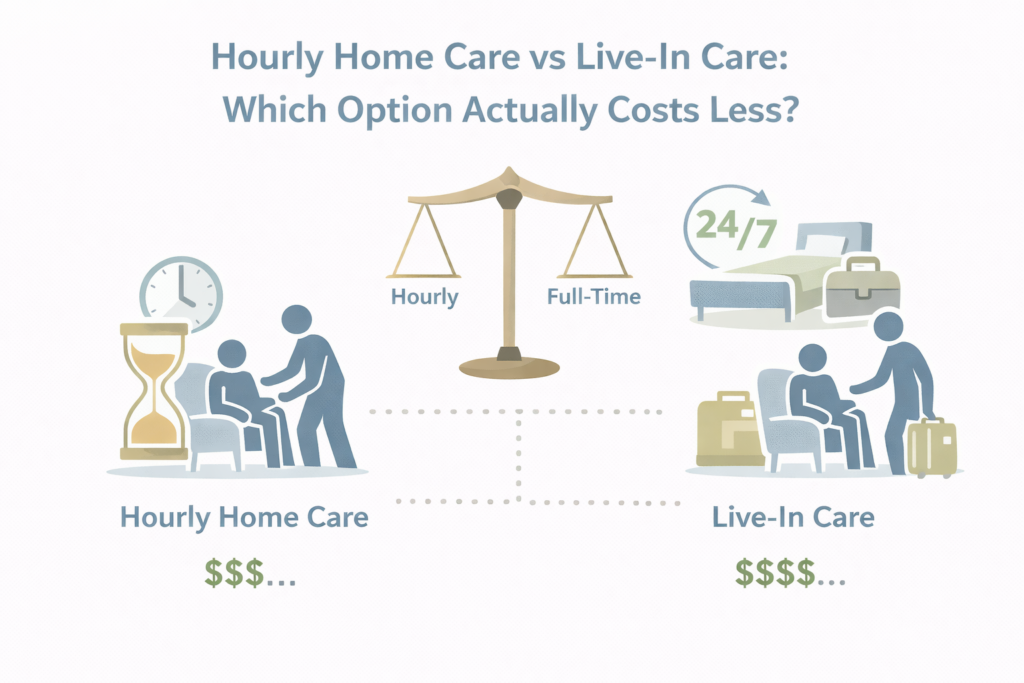
Is it cheaper to pay for hourly home care — or to switch to live-in care?
At first glance, live-in care can sound more affordable. In practice, the answer depends on how many hours of help are truly needed and how flexible the household can be. This article explains how costs differ, where families often miscalculate, and when one option quietly becomes more expensive than the other.
Why This Comparison Is Harder Than It Seems
Hourly care and live-in care are priced very differently.
- Hourly care scales directly with time
- Live-in care is usually a flat daily or weekly rate, but comes with limitations
Many families compare the numbers without accounting for coverage gaps, overtime rules, and supervision needs, which is where cost assumptions often break down.
Typical Cost Ranges (U.S.)
While rates vary by region and provider, national averages help frame the comparison.
Hourly Home Care
National benchmarks often place agency hourly rates around the low-to-mid $30s, but local quotes can be higher or lower.
- Average hourly rate: $28–$35
- Around 40 hours/week can land around ~$5,000–$6,500/month in many markets, depending on local rates and agency minimums.
- 60+ hours per week: $7,000–$9,000+ per month
Hourly care works best when:
- Coverage is limited to specific times of day
- Overnight supervision is not required
- Family members can reliably cover remaining hours
Once hours increase, costs rise quickly.
Live-In Home Care
- Typical monthly cost: $6,000–$10,000
Live-in care is typically priced lower than true 24-hour rotating-shift coverage because it does not provide continuous awake overnight supervision.
- Pricing usually assumes:
- One caregiver living in the home
- Required daily rest periods
- Limited overnight duties
Live-in care is not the same as 24-hour care. Most arrangements do not include continuous overnight supervision. Families often review “How Much Does 24-Hour In-Home Care Cost Per Month?” to understand how live-in care differs from round-the-clock coverage.
When Hourly Care Is Usually Cheaper
Hourly care is often the lower-cost option when:
- Care needs are predictable and limited
- Assistance is needed only during the day
- The individual sleeps safely through the night
- Family members can step in consistently
In these cases, families pay only for the hours they need — and avoid paying for unused coverage. However, this balance is fragile. Adding even a few extra hours per day can quickly push costs higher.
When Live-In Care Becomes More Cost-Effective
Live-in care often costs less than high-hour hourly care when:
- Daily care needs approach 10–12 hours
- Supervision is needed throughout the day
- Multiple hourly caregivers would otherwise be required
- Care schedules are becoming difficult to manage
At this point, families are no longer just paying for care hours — they’re paying for coordination, shift coverage, and caregiver turnover. Live-in care simplifies scheduling, which can reduce hidden costs.
The Trade-Off Families Often Overlook
The cost difference isn’t just about the monthly total. It’s about what the care arrangement can realistically handle. Hourly care offers flexibility, but becomes expensive as needs grow.
Live-in care offers consistency, but has limits — especially overnight. Families who assume live-in care replaces all supervision often discover too late that additional help is still needed, increasing costs unexpectedly.
A Better Way to Compare the Two
Instead of asking which option is cheaper, families get clearer answers by asking:
How many hours of active help are truly needed — and when?
If care needs are limited and stable, hourly care often costs less. If care needs are long, continuous, or difficult to schedule, live-in care can be the more practical choice. Understanding this distinction prevents families from choosing an option that looks affordable — but becomes unsustainable.
What Families Usually Do Next
Most families compare real schedules and real pricing from local providers. Rates, overtime rules, and caregiver availability vary widely by area, so reviewing actual options often clarifies which model makes financial sense before costs escalate. Evaluating agencies and service structures also matters, which is why families often consult “How to Choose a Home Care Provider: What Families Should Look For Before Hiring.”
The Bottom Line
Hourly home care costs less when care needs are limited and predictable. Live-in care costs less when care demands are long, continuous, and hard to coordinate. The goal isn’t to find the cheapest option — it’s to choose the one that remains workable as care needs change.