
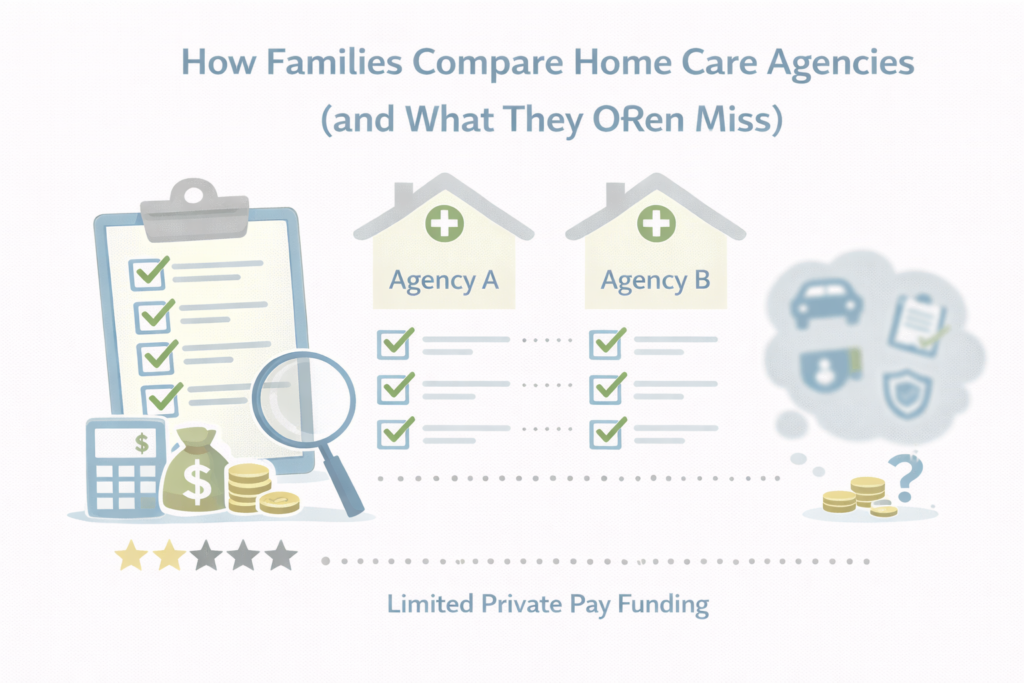
After families decide that in-home care is the right direction, a new challenge appears:
choosing a home care agency.
At this point, many families feel they’ve already done the hard work.
In reality, this is where costs, quality, and stress levels diverge the most—often because of how agencies are compared.
This guide focuses on the comparison process itself:
what families typically look at, what they overlook, and how small assumptions lead to big differences later.
How Families Usually Start Comparing Agencies
Most families begin with a short list based on:
- Availability
- Location
- Initial hourly rate
- Online reviews
This is understandable—and incomplete.
Those factors help narrow options, but they rarely predict whether an agency will remain workable over time.
The Comparison Questions That Matter Most (But Come Later)
As families gain experience with care, different questions become more important.
1. How Is Care Actually Scheduled?
Agencies differ in:
- Minimum hours per visit
- Weekend and holiday rules
- Overtime thresholds
- How coverage gaps are handled
Two agencies with the same hourly rate can produce very different monthly bills depending on scheduling policies.
2. What Happens When Care Needs Change?
Care needs almost always increase.
Families often miss:
- How easily hours can be added
- Whether the same caregiver can stay as needs grow
- What triggers reassessments or care plan changes
An agency that works well at 20 hours a week may struggle at 40 or more.
3. Who Oversees Care—And How Often?
Oversight varies widely:
- Some agencies provide regular supervisory visits
- Others intervene only after problems are reported
Families often assume oversight is standard.
It isn’t.
Lack of oversight can lead to inconsistent care, caregiver turnover, and coordination problems—none of which show up in initial quotes.
Common Assumptions That Cause Problems Later
“The Hourly Rate Tells Us Enough”
Hourly rates are easy to compare and easy to misunderstand.
They don’t reflect:
- Scheduling inefficiencies
- Missed shifts
- Emergency coverage
- Turnover-related disruptions
Families frequently discover that structure matters more than price.
“If We Don’t Like a Caregiver, We’ll Just Switch”
Switching caregivers is possible—but not frictionless.
Frequent changes can:
- Increase stress for the person receiving care
- Require repeated adjustment periods
- Signal staffing instability within the agency
Stability often depends on how agencies recruit, train, and retain caregivers—not just their willingness to replace them.
“All Agencies Handle Problems the Same Way”
They don’t.
Families rarely ask:
- How complaints are handled
- How quickly issues are escalated
- Who the point of contact actually is
When problems arise—and they usually do—these differences become very visible.
A More Reliable Way to Compare Agencies
Instead of asking “Which agency is cheapest?”, families tend to get clearer results by asking:
“Which agency is most likely to work as care needs increase?”
This reframes the comparison around:
- Flexibility
- Oversight
- Care continuity
- Long-term coordination
Agencies that appear more expensive upfront sometimes prove more manageable over time.
What Families Often Realize Too Late
Many families only recognize these differences after:
- Costs rise unexpectedly
- Care schedules become hard to manage
- Family members step in to fill gaps
- Switching agencies feels disruptive
At that point, choices are more limited.
Comparing agencies thoroughly at the start doesn’t eliminate challenges—but it reduces avoidable ones.
How This Fits Into the Overall Care Picture
Choosing a home care agency isn’t a one-time decision.
It shapes how care evolves, how costs change, and how much coordination families absorb.
Families navigating this stage often benefit from reviewing:
- Hourly Home Care vs Live-In Care to understand how structure affects sustainability
- In-Home Care Costs to see how pricing escalates as needs change
- When In-Home Care Becomes Too Expensive to recognize warning signs early
- Private Pay Home Care: How Long Can Families Realistically Afford It? to plan beyond short-term affordability
Together, these resources help families move from choosing an agency to building a care plan that holds up over time.