
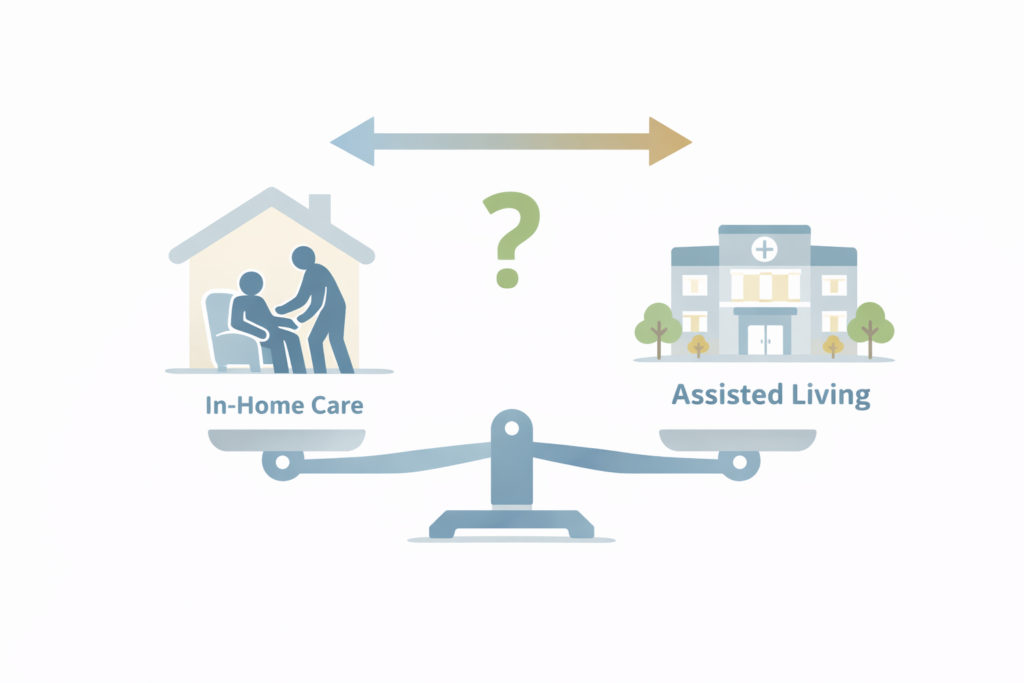
When families compare in-home care and assisted living, they are rarely choosing between two equally appealing options. More often, they are trying to answer a harder question:
How long is it realistic to stay at home — and what happens when that stops being true?
This article compares in-home care and assisted living from a practical decision-making perspective, focusing on how families typically evaluate cost, daily needs, safety, and long-term sustainability. This comparison reflects how families typically evaluate care decisions based on current U.S. care structures and common practices.
What In-Home Care and Assisted Living Actually Offer
Although these options are often compared, they are designed to solve different problems.
In-Home Care
In-home care provides non-medical assistance in a person’s own home.
Support is added gradually and adjusted over time.
Common features include:
- Help with daily activities (bathing, dressing, meals)
- Companionship and supervision
- Flexible scheduling (a few hours to many hours per day)
- Familiar environment and routines
In-home care works best when independence still matters and care needs are manageable at home.
Assisted Living
Assisted living offers housing combined with daily support in a community setting.
Typical features include:
- Private or semi-private apartments
- Staff available for daily assistance
- Meals, housekeeping, and activities included
- A more predictable, structured environment
Assisted living is designed for situations where staying at home becomes increasingly difficult or unsafe.
How Families Usually Compare the Two
Most families do not compare these options all at once.
They move through a sequence of questions.
1. Daily Needs vs Daily Supervision
A key distinction is how much supervision is needed, not just how much help.
- In-home care works when assistance is needed at specific times of day.
- Assisted living becomes more relevant when supervision is needed throughout the day.
If safety concerns arise during unsupervised hours, families often begin to reassess whether the home setting is still workable.
2. Cost Over Time, Not Just Monthly Cost
At lower levels of care, in-home care may appear less expensive because families pay only for the hours used.
However, costs can rise significantly as:
- Care hours increase
- Overnight or weekend support becomes necessary
- Multiple caregivers are required
Assisted living costs are typically more predictable month to month, even if the upfront number feels higher. For many families, the financial comparison shifts when care extends into most of the day, especially as hourly costs accumulate over time.
3. Flexibility vs Sustainability
In-home care is highly flexible.
Assisted living is more standardized.
That flexibility can be a strength early on, but it can also place increasing responsibility on family caregivers to coordinate schedules, fill gaps, and respond to changes.
Assisted living shifts more of that coordination to the facility itself, which some families find relieving over time.
Safety Often Becomes the Turning Point
Many families do not change care settings because of cost alone.
They change because risk increases faster than support can realistically be added at home.
Common tipping points include:
- Falls or near-falls
- Nighttime wandering or confusion
- Difficulty with transfers or mobility
- Caregivers becoming physically exhausted
Before increasing care hours, families sometimes explore basic home safety adjustments — such as mobility support or bathroom safety aids — to stabilize the situation.
These steps can help in the short term, but they do not replace supervision when safety risks become constant.
When In-Home Care May No Longer Be Enough
Families often begin to consider assisted living when:
- Care is needed most hours of the day
- Safety concerns occur outside scheduled care times
- Managing care at home becomes emotionally or physically overwhelming
- The home environment can no longer be adapted effectively
At this stage, understanding how in-home care is typically paid for can help families assess long-term feasibility.
How Families Typically Transition
Very few families move directly from independence to assisted living.
A more common progression looks like:
- Independent living with occasional help
- Part-time in-home care
- Expanded care hours and home modifications
- Re-evaluation when care demands exceed what can be managed at home
- Transition to assisted living
Understanding this progression helps families plan earlier, rather than reacting during a crisis.
Which Option Is “Better”?
There is no universally better choice.
In-home care tends to work best when:
- Care needs are moderate
- Safety risks are manageable
- Family involvement is sustainable
Assisted living becomes more appropriate when:
- Supervision needs increase
- Daily care becomes continuous
- Home-based solutions are no longer sufficient
The right decision depends less on labels and more on what daily life actually requires right now.
A Practical Perspective
Comparing in-home care and assisted living is not about choosing comfort over care, or independence over safety.
It is about recognizing when flexibility turns into strain — and when structure becomes support.
Families who revisit this decision early tend to have more options and fewer regrets.
Next Steps
- Review typical cost structures for in-home care and assisted living
- Identify early safety signals that may require more support
- Consider whether current care arrangements are sustainable long-term