
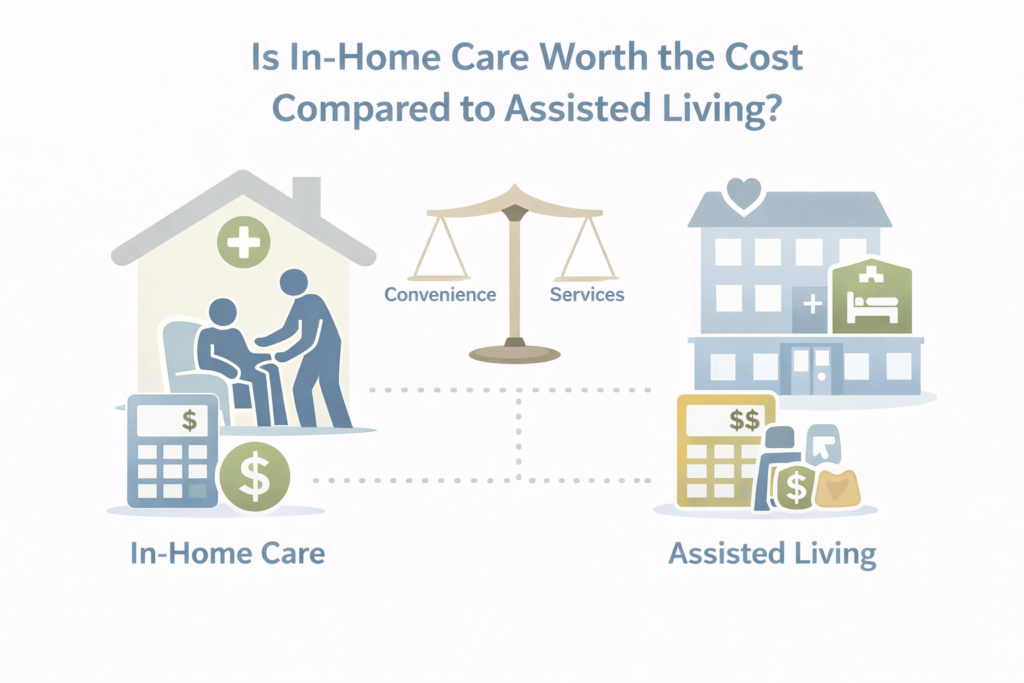
When families begin comparing in-home care and assisted living, the real question is rarely which option is better.
More often, it’s whether staying at home is still financially realistic — and for how long.
Both options can make sense. Both can become expensive quickly.
The difference lies in how costs grow over time and when each option stops being sustainable.
This guide focuses on that reality, without assuming one choice fits every family.
Why This Cost Comparison Is More Complicated Than It Looks
At first glance, assisted living often appears more expensive.
In practice, many families are surprised to learn that full-time in-home care can exceed assisted living costs once care needs increase.
The reason is simple:
- In-home care costs scale by the hour
- Assisted living typically charges a base monthly rate, with add-ons for care
- Many families confuse live-in care with 24-hour care, even though live-in arrangements usually include required rest periods and limited overnight supervision.
Knowing where those two curves cross is critical to deciding which option is actually “worth it.”
Typical Monthly Cost Ranges (U.S.)
While costs vary widely by region and level of care, national averages help set expectations.
In-Home Care
- Hourly care: $28–$35 per hour
- Around 40 hours per week: roughly $4,500–$6,500 per month, depending on local rates and agency minimums
- Live-in care (not the same as 24-hour supervision): typically ~$6,000–$10,000 per month
- 24-hour care with rotating shifts (billed hourly): often ~$22,000–$26,000+ per month, depending on location and scheduling premiums
For a more detailed breakdown of how extended care costs add up, families often review “How Much Does 24-Hour In-Home Care Cost Per Month?”
Costs increase with:
- Overnight coverage
- Weekend and holiday hours
- Specialized support (mobility assistance, dementia care)
Assisted Living
Most national surveys place the typical total monthly cost of assisted living in the $5,500–$7,000 range, with higher costs in some regions and for higher care levels.
- Base monthly fee: $4,500–$6,500
- Care-level add-ons: $500–$2,000+
As a result, many families see total assisted living costs fall roughly in the $5,500–$8,000 per month range, depending on location and care needs. These ranges are consistent with industry surveys such as Genworth’s Cost of Care reports and state-level planning data.
When In-Home Care Is Often Worth the Cost
In-home care usually provides the most value when:
- Care needs are part-time or moderate
- The individual can safely be alone for portions of the day
- Family members can help fill coverage gaps
- The primary goal is to delay a move, not replace full-time supervision
In these cases, families are paying for targeted assistance, not continuous oversight.
That’s where in-home care tends to be both emotionally and financially effective.
Families comparing daily support models often find it helpful to review “In-Home Care vs Assisted Living: How Families Decide” to understand how care needs typically evolve.
When Assisted Living Becomes the More Sustainable Choice
Assisted living often becomes more practical when:
- Care needs approach 24-hour supervision
- Safety concerns increase (falls, wandering, missed medications)
- Coordinating multiple caregivers becomes difficult
- Monthly in-home care costs rival or exceed assisted living fees
At this stage, the issue is rarely just cost.
It’s the complexity and unpredictability of managing care at home.
Many families reach this point after realizing that staying at home requires more coordination — and financial flexibility — than they anticipated.
The Cost Factor Families Often Overlook
The most important question isn’t the monthly total.
It’s how long each option remains affordable.
Some families can manage high in-home care costs for several months, but struggle to sustain them long-term.
Assisted living, while emotionally challenging, often provides:
- More predictable expenses
- Fewer sudden cost spikes
- Built-in supervision and care continuity
Understanding payment structures can also influence how long care remains feasible.
Families frequently look at “Who Pays for In-Home Care? Understanding Common Payment Options and Limits” when planning ahead.
A Better Question to Ask
Instead of asking which option is cheaper, families tend to get better clarity by asking:
“How much care is needed now — and how likely is that to increase?”
If care needs are stable, in-home care may be worth the cost.
If needs are escalating, assisted living often becomes the more sustainable solution.
Neither option is universally right — timing matters.
What Families Usually Do Next
Most families don’t decide immediately.
They begin by comparing real options, real services, and real pricing in their area.
Because availability and costs vary widely by location, reviewing actual providers often clarifies whether staying at home or transitioning to assisted living makes more sense financially.
Evaluating agencies and service quality also plays a role, which is why families often consult “How to Choose a Home Care Provider: What Families Should Look For Before Hiring.”
The Bottom Line
In-home care is worth the cost when it delays more intensive care without creating long-term financial strain.
Assisted living is worth the cost when it replaces rising care needs with predictable, comprehensive support.
The goal isn’t to choose the “better” option —
it’s to choose the one that remains workable as circumstances change.