
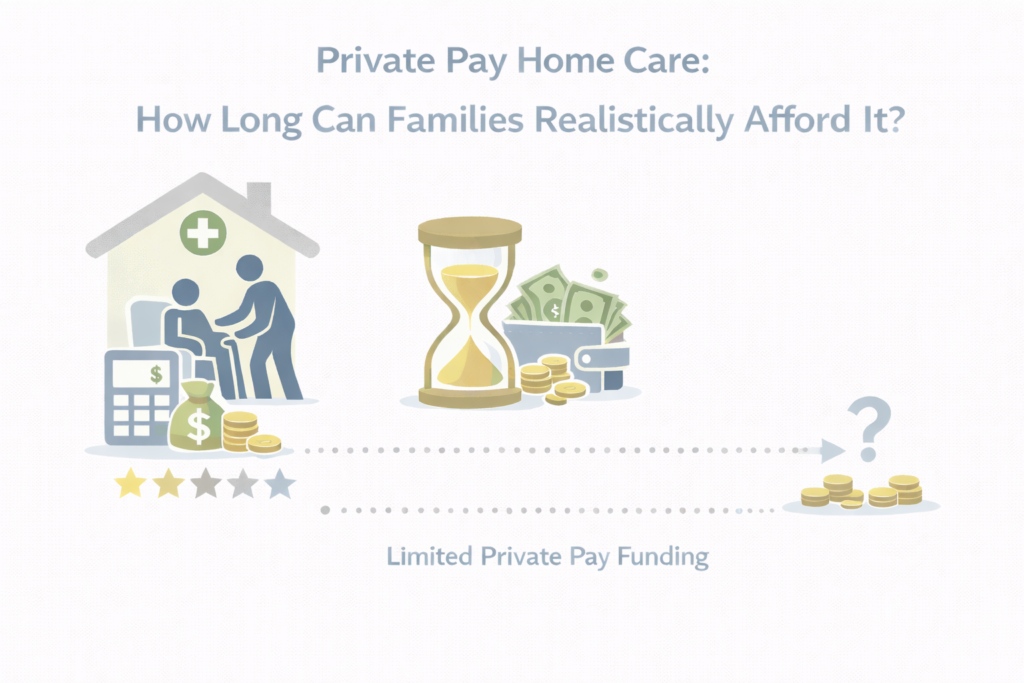
For many families, private pay home care begins as a practical solution. It offers flexibility, faster access to care, and the ability to adjust support as needs change.
But over time, a harder question often emerges:
How long can private pay home care realistically be sustained?
This article explains how private pay costs typically evolve, why affordability changes faster than many families expect, and how families recognize when private pay is no longer a long-term solution.
What “Private Pay” Actually Means in Practice
Private pay refers to paying for in-home care without relying on Medicaid assistance.
This can include:
- Paying a home care agency directly
- Hiring an independent caregiver
- Sharing costs among family members
- Using long-term care insurance benefits (when available)
Private pay offers flexibility and immediate access. However, it also means that costs increase directly with care hours, without external caps or guarantees.
Why Private Pay Often Feels Affordable at First
Most families begin private pay home care at a limited level.
Common starting points include:
- A few hours per day
- Help with meals, bathing, or companionship
- Daytime support only
At this stage, monthly costs may feel manageable—especially when compared to residential care options. But private pay affordability is often temporary.
How Private Pay Costs Typically Escalate
Private pay home care rarely becomes unaffordable all at once. Costs usually rise in predictable stages.
1. Hours Increase Gradually
Care often expands from part-time to extended daily coverage.
- 10–20 hours per week becomes 30–40
- Evenings and weekends are added
- Family caregivers fill fewer gaps
Each increase raises monthly costs without changing the underlying payment structure.
2. Overnight or Supervision Needs Appear
Once overnight supervision or safety monitoring becomes necessary, costs accelerate quickly. Even without true 24-hour coverage, adding night hours or emergency availability significantly raises monthly spending.
3. Care Becomes Continuous Rather Than Task-Based
When care shifts from helping with specific tasks to providing ongoing supervision, private pay costs move into a different category entirely. At this point, families are no longer paying “for help”— they are paying to maintain full coverage.
How Long Can Most Families Sustain Private Pay?
There is no single answer, but patterns are consistent.
Private pay is most sustainable when:
- Care needs are part-time or moderate
- Family members can reliably assist
- Care hours remain predictable
- Costs fit within existing retirement income or savings plans
It becomes harder to sustain when:
- Care approaches full-time or continuous coverage
- Monthly costs rival housing or total household income
- Family members reduce work hours or experience burnout
- Savings are being depleted faster than expected
Many families discover that private pay works well for months, but becomes difficult over multiple years as care needs increase.
The Hidden Risk: Assuming Costs Will Stay Stable
One of the most common planning mistakes families make is assuming current care costs will remain stable.
In reality:
- Care needs almost always increase
- Hourly rates may rise over time
- Scheduling changes introduce premiums
- Emergency coverage adds unpredictable costs
Private pay has no built-in ceiling. Affordability depends entirely on how long current care needs remain unchanged.
When Families Begin Reassessing Private Pay
Families typically reconsider private pay when:
- Monthly costs rise faster than anticipated
- Care coordination becomes overwhelming
- Savings depletion becomes visible
- Long-term affordability becomes uncertain
At this point, families often begin exploring:
- Adjusting the care model (hourly vs live-in)
- Long-term care insurance benefits
- Medicaid eligibility and timing
- Assisted living or other residential options
This reassessment is not a failure—it is a normal stage in long-term care planning.
A More Useful Question Than “Can We Afford This?”
Rather than asking “Can we afford private pay right now?”, families often gain clarity by asking:
“How long can we sustain this level of care if needs continue to increase?”
This shifts the focus from short-term affordability to long-term feasibility. Private pay is often most effective as a bridge, not a permanent solution.
How This Fits Into the Overall Care Picture
Families considering the long-term affordability of private pay often benefit from reviewing:
- In-Home Care Costs in 2026 to understand how pricing scales
- What Happens When In-Home Care Becomes Too Expensive to recognize warning signs
- Hourly Home Care vs Live-In Care to evaluate alternative structures
- In-Home Care vs Assisted Living to compare sustainability over time
Together, these resources help families plan proactively—before financial pressure limits their options.
The Bottom Line
Private pay home care offers flexibility and control, especially in the early stages of care. But its affordability depends on how quickly care needs change. Families who plan for escalation—not just current costs—retain more choices and avoid rushed decisions later. Private pay works best when used intentionally, with a clear understanding of its limits.