
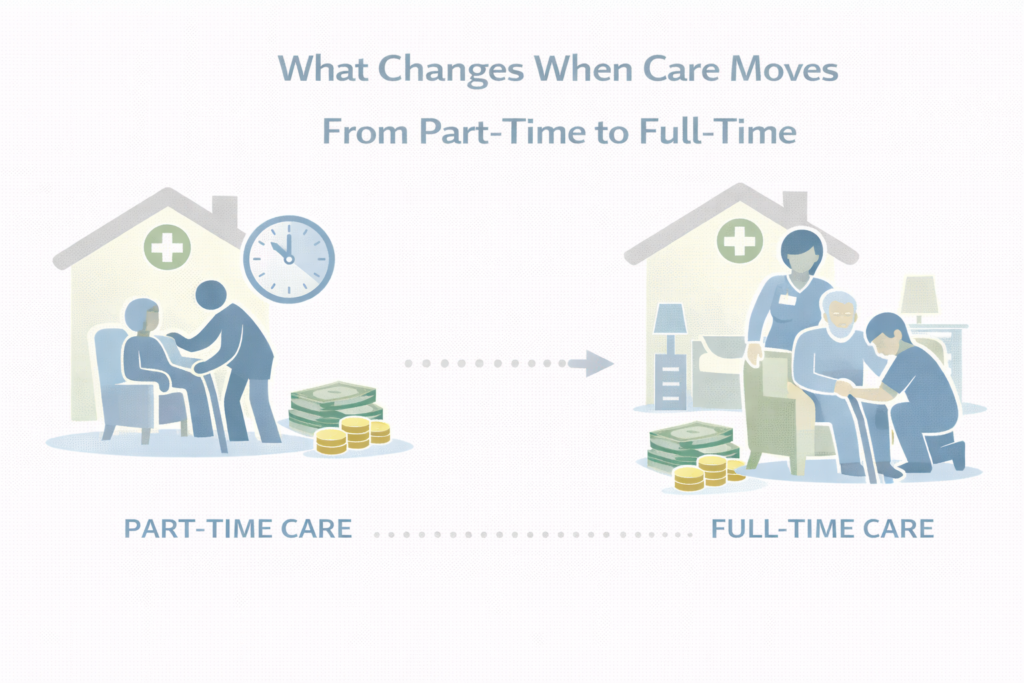
For many families, the move from part-time care to full-time care doesn’t feel like a decision.
It feels like a series of small adjustments that quietly add up. An extra visit here. A longer shift there. Coverage that starts earlier and ends later. At some point, families realize that care is no longer something that “fits around” daily life — it is daily life. This shift changes more than the schedule. It changes how care is experienced, managed, and sustained.
How Part-Time Care Usually Works
When care is part-time, it typically supports specific needs rather than the entire day.
Families often rely on part-time care to:
- Help with meals, bathing, or medication reminders
- Provide companionship during certain hours
- Cover gaps when family members are working or unavailable
At this stage, care still feels like assistance layered onto an existing routine. Family members remain deeply involved, but the responsibility feels shared and manageable.
What “Full-Time Care” Actually Means
Full-time care doesn’t have a single definition. For most families, it begins when care coverage stretches across most of the day — even if it isn’t technically 24 hours.
This often includes:
- Long daytime shifts with limited breaks
- Coverage that extends into evenings or early mornings
- Fewer hours when the older adult is truly alone
- Family members no longer able to “fill the gaps” reliably
The key change isn’t just the number of hours. It’s that care begins to define the structure of the household.
How Daily Life Changes First
When care becomes full-time, families often notice practical changes before emotional ones.
Schedules Become the Priority
Daily routines start revolving around caregiver arrival times, shift changes, and handoffs. Family plans become harder to make spontaneously, and flexibility narrows.
The Home Feels Different
More people moving through the space means less privacy. Even when caregivers are respectful, families often feel like the home is no longer fully their own.
Coordination Becomes Ongoing Work
Confirming schedules, handling last-minute changes, and ensuring continuity takes time and attention — usually from family members, not providers. Care no longer feels like a service that “runs in the background.” It becomes something that must be actively managed.
How Family Roles Shift
One of the most significant changes at this stage is how family involvement evolves. With part-time care, family members often act as helpers or backups. With full-time care, they often become coordinators.
This can mean:
- Managing communication between multiple caregivers
- Tracking what was done, what changed, and what needs attention
- Stepping in during cancellations or coverage gaps
- Remaining emotionally “on call” even when paid care is present
Many families are surprised to find that full-time care doesn’t necessarily reduce their involvement — it changes the type of involvement.
When Care Transitions From Help to Supervision
Another major shift occurs when care is no longer about completing tasks, but about ongoing supervision.
This can happen when:
- Safety concerns increase
- Confusion or wandering becomes more likely
- Falls or nighttime risks emerge
- The older adult can no longer be left alone for extended periods
At this point, families aren’t just arranging assistance. They’re trying to maintain continuous awareness and protection — which is a fundamentally different care need.
Why This Stage Often Feels Unsettling
Many families expect full-time care to feel like a solution. Instead, it often introduces a new kind of uncertainty.
Common feelings include:
- A sense that life is now organized around care
- Worry about sustainability — emotional, logistical, or financial
- Ongoing vigilance despite increased coverage
- Questions about how long this arrangement can realistically continue
These feelings don’t mean something has gone wrong. They reflect the reality that full-time care is a threshold, not an endpoint.
What Families Begin Questioning at This Point
As care becomes full-time, families often stop asking whether they can “add more help” and start asking different questions:
- Is this level of coordination realistic long term?
- Are we maintaining stability — or just preventing crises?
- Does this structure still work as needs continue to change?
These questions don’t automatically lead to a decision. But they signal that care planning has entered a new phase.
How This Fits Into the Broader Care Path
Families navigating the move to full-time care often find it helpful to explore related decisions, including:
- Hourly Home Care vs Live-In Care: Which Option Actually Costs Less?
- When Increasing In-Home Care Hours Stops Solving the Problem
- In-Home Care vs Assisted Living: How Families Decide and When a Transition Makes Sense
Together, these resources help families understand not just what care options exist, but when different structures tend to make sense.
Bottom Line
Moving from part-time to full-time care changes the nature of caregiving. Care shifts from supporting daily life to shaping it. Recognizing this transition early helps families assess whether their current setup is still sustainable — and whether the structure of care, not just the number of hours, deserves a closer look.