
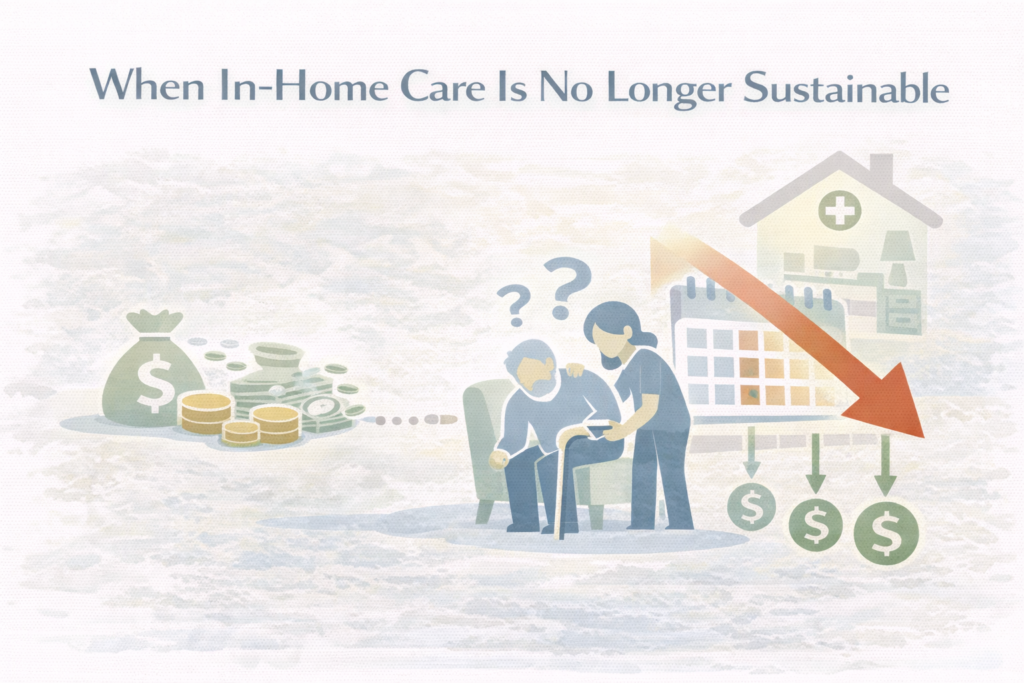
In-home care often begins as a practical solution. It allows an older adult to stay in a familiar environment while receiving help with daily activities. At first, this approach can feel flexible and manageable. Over time, however, many families reach a point where the current care arrangement becomes harder to sustain.
This article explains when in-home care may no longer be sustainable, what signals families typically notice first, and why the issue is often about structure rather than preference.
Why In-Home Care Usually Starts Out Manageable
Most families begin with limited support: a few hours a day, help with meals or bathing, and occasional supervision. At this level, care can fit around family schedules and retirement income more easily. Families pay only for the hours they use, and care can be adjusted as needs change.
Using national median agency rates of around $34 per hour, part-time care at 20 hours per week costs about $2,900 per month, while full-time daytime care at 40 hours per week costs roughly $5,900 per month. These benchmarks are explained in more detail in In-Home Care Costs in 2026. At this stage, staying at home often appears less expensive than moving into a residential setting.
How Sustainability Changes as Care Needs Grow
The challenge rarely comes from one sudden increase. It comes from a series of adjustments that gradually reshape daily life.
Care hours expand beyond the original plan. Evenings and weekends are added. Family members fill fewer gaps as schedules become harder to manage. Eventually, supervision becomes more important than task-based help.
Once care approaches most hours of the day, the structure changes. In-home care shifts from being occasional support to continuous coverage. This transition usually increases both cost and coordination demands, making it harder for families to maintain the same arrangement over time.
Financial Signals That Care Is Becoming Harder to Sustain
For many households, the first pressure point is financial. Common warning signs include monthly care costs approaching or exceeding housing expenses, savings withdrawals increasing faster than expected, and family members reducing work hours to avoid adding paid care.
In-home care funded through private pay home care has no built-in ceiling. As hours increase, costs rise directly with them. This makes long-term predictability difficult, especially when care needs continue to change.
Practical Signals Beyond Cost
Sustainability is not only about money. It is also about whether daily life remains workable.
Families often begin to struggle when overnight supervision becomes necessary, when safety concerns appear outside scheduled care times, or when coordinating multiple caregivers becomes emotionally or physically exhausting. Missed shifts, emergency coverage, and frequent schedule changes can turn a flexible system into a fragile one.
At this stage, the issue is not whether in-home care is a good idea in theory. It is whether it can realistically support current needs without constant crisis management.
Why Families Often Delay Reassessing
Many families hesitate to question the sustainability of in-home care because staying at home feels emotionally right. A move can feel like a loss of independence or a disruption of routine. Others focus on the current monthly bill rather than the long-term pattern.
However, postponing the comparison can narrow options. When decisions are made under financial or safety pressure, availability and choice are more limited. This is why families who revisit their care model earlier tend to retain more flexibility.
When a Different Structure Becomes More Realistic
In-home care may no longer be the most sustainable option when care is needed most hours of the day, when safety concerns occur during unsupervised times, or when managing care at home becomes overwhelming for family caregivers. At that point, families often begin comparing their current setup with more structured alternatives.
A broader explanation of how families make this comparison can be found in In-Home Care vs Assisted Living, which outlines how supervision, cost stability, and daily coordination differ between home-based and residential care.
A More Useful Question to Ask
Instead of asking, “Can we keep this going right now?”, families often gain clarity by asking, “What care model can we realistically sustain if needs continue to increase?” This reframes the decision from short-term coping to long-term feasibility.
Sustainability is not about choosing between comfort and care. It is about recognizing when flexibility turns into strain and when a more structured environment becomes support rather than loss.
How This Fits Into the Larger Care Picture
Families evaluating whether in-home care is still workable often benefit from reviewing how care costs scale, how private pay evolves over time, and how residential options compare in long-term predictability. Together, these perspectives help shift planning from reactive adjustments to proactive decisions.
The Bottom Line
In-home care works best when care needs are moderate and predictable. It becomes harder to sustain when supervision becomes continuous, costs accelerate, and coordination overwhelms family routines. Recognizing these changes early allows families to consider alternatives while more options are still available.
The goal is not to abandon home care prematurely. It is to understand when the current structure no longer matches daily reality, and to plan the next step before urgency removes choice.