
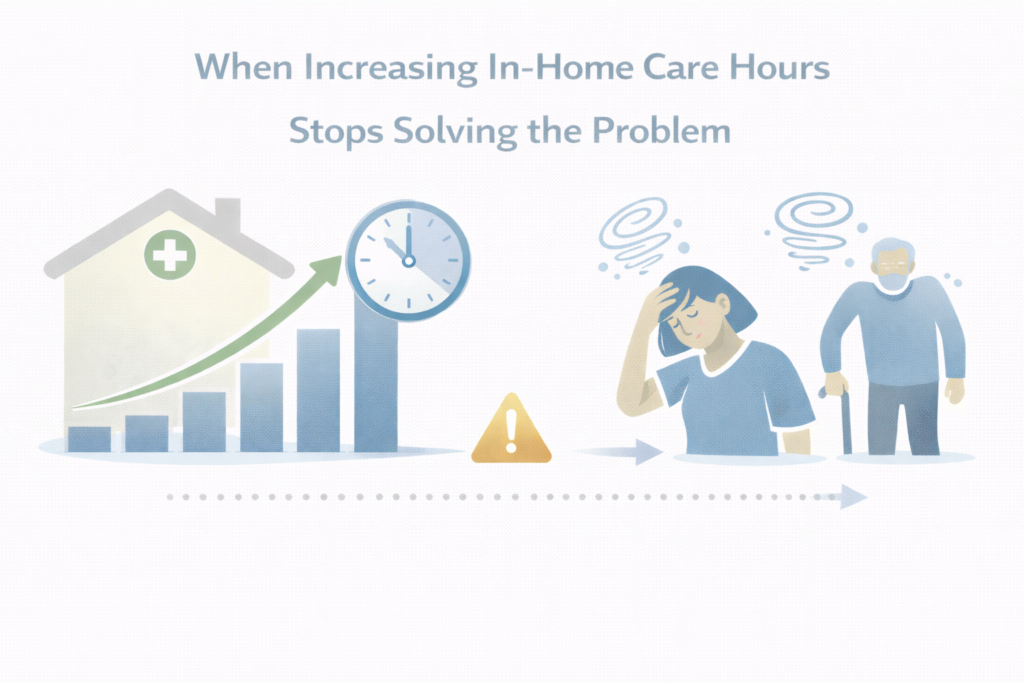
When care needs increase, most families respond the same way: they add more hours. At first, it makes sense. More coverage should mean more stability. But many families reach a point where increasing in-home care hours doesn’t reduce stress or risk—it simply increases cost and complexity. This is a common turning point in long-term care planning. It’s also one of the clearest signals that the current care model may be approaching its limits.
Why Families Increase Hours in the First Place
Families usually add hours for practical reasons, not because they want “more care” in general. Common triggers include:
- A fall, near-fall, or a new safety concern
- Medication mix-ups or missed meals
- Wandering risk or nighttime confusion
- Increasing help needed with bathing, dressing, or toileting
- A family caregiver returning to work—or burning out
- A doctor or hospital discharge recommending closer supervision
In other words, more hours often start as a reasonable response to a real change.
The Early Relief That Doesn’t Last
When hours increase from a small schedule to more consistent daytime coverage, families often feel immediate relief:
- The older adult is less alone
- Daily routines become easier
- Family members can breathe again
But this “better” phase is often temporary—because the need that caused the increase rarely stays fixed. As needs change, schedules expand again. Eventually the family isn’t just purchasing help with tasks. They’re trying to purchase enough coverage to prevent problems.
When More Hours Start Creating New Problems
Adding hours can solve some issues while introducing others. When families say, “We’re paying more but it still doesn’t feel stable,” these are usually the reasons.
1) Coverage gaps become the real issue
A schedule can look “big” on paper and still leave risky gaps:
- Early mornings
- Dinner and bedtime routines
- Overnight supervision
- Weekends and holidays
- Unexpected cancellations
Families often discover the hard part isn’t adding hours—it’s covering the hours that matter most.
2) Scheduling becomes harder to manage than the care itself
As hours grow, the coordination work grows too:
- Multiple caregivers rotating through
- Frequent confirmations, rescheduling, and backups
- Different approaches to routines and preferences
- Communication mistakes (what was done, what wasn’t)
Even with a good agency, complex schedules take real management—usually by family.
3) Consistency becomes unpredictable
Many families expect that paying more will bring continuity. In reality, larger schedules can mean more caregiver rotation, which can lead to:
- Confusion about routines
- Frustration or resistance from the older adult
- More time “retraining” new caregivers
- A feeling that the household is always adjusting
When care is mostly task-based, this is manageable. When supervision is the goal, inconsistency becomes a bigger problem.
4) Safety needs shift from “help” to “supervision”
This is the biggest change.
Once the need becomes ongoing supervision—especially at night—families often realize they aren’t purchasing assistance anymore. They’re trying to purchase continuous protection. That is a different category of care, and it behaves differently in cost, staffing, and sustainability.
Signs That Increasing Hours Is No Longer Improving Stability
Not every situation reaches this stage, but when it does, the signs are fairly consistent.
Families often notice:
- Increasing hours doesn’t reduce worry—it just reduces guilt
- The older adult still isn’t safe during uncovered times
- Family caregivers still feel “on call” even with paid help
- The schedule is becoming hard to staff consistently
- Costs rise faster than the sense of stability
- The household feels like it’s running a care operation
At this point, adding hours can feel like buying time rather than solving the underlying problem.
What Families Usually Try Before Making Bigger Changes
Before considering a major shift, many families attempt adjustments to make the current model work better. Common moves include:
- Re-structuring hours around high-risk times (mornings, evenings, nights)
- Shifting from many short visits to fewer longer shifts
- Testing whether a live-in arrangement would reduce coverage gaps
- Formalizing family responsibilities so expectations are clearer
- Tightening routines to reduce caregiver turnover or confusion
These steps can help—especially when care needs are moderate and predictable. But if supervision needs continue to expand, families often end up facing the same question again in a few months.
The Real Question Isn’t “Can We Add Hours?”
The better question is:
“Are we adding hours because care needs are increasing—or because the current model can’t provide stable coverage anymore?”
When hours increase because needs are increasing, the plan may still hold. When hours increase because stability is disappearing, families usually need to compare a different structure—not just a larger schedule.
What Often Comes Next
Once families recognize that more hours aren’t producing stability, they typically begin comparing options that offer:
- More continuous coverage
- More predictable support
- Less coordination burden on family
For some families, that means adjusting the in-home model. For others, it means comparing different care settings.
If you’re at this stage, these guides often help clarify the next decision:
- Private Pay Home Care: How Long Can Families Realistically Afford It?
- Hourly Home Care vs Live-In Care: Which Option Actually Costs Less?
- What Happens When In-Home Care Becomes Too Expensive
- In-Home Care vs Assisted Living: Comparing Long-Term Sustainability
Bottom Line
Increasing in-home care hours is often the first—and most reasonable—response to rising needs. But when more hours stop improving stability, the problem usually isn’t effort or planning. It’s that the care model is nearing its practical limits for the level of supervision required. Recognizing that moment earlier can reduce rushed decisions later—and help families choose an option that’s sustainable in real life, not just on paper.