
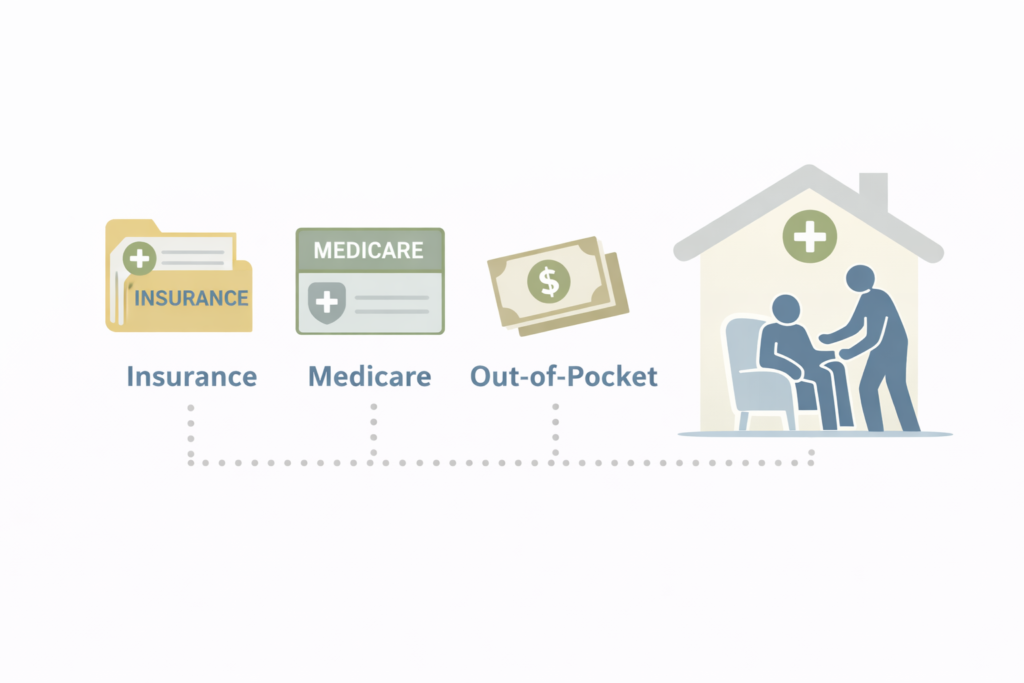
When families begin using in-home care, one of the first questions that surfaces is not about services — it’s about payment.
Who actually pays for in-home care, and for how long?
This article explains how in-home care is commonly paid for in the United States, what programs may help in specific situations, and where families often misunderstand coverage. This information reflects current U.S. care payment structures as of early 2026.
Why Payment Becomes a Central Question
Unlike medical care, most in-home care services are non-medical and ongoing.
That distinction affects how care is funded.
Many families assume:
- Insurance will cover most costs
- Coverage will expand as needs increase
- Government programs function like long-term care insurance
In reality, payment structures for in-home care are more limited and more fragmented.
The Most Common Way In-Home Care Is Paid For
Out-of-Pocket Payment
For most families, out-of-pocket payment is the primary way in-home care is funded.
This includes:
- Hourly payments to home care agencies
- Direct payment to independent caregivers
- Shared costs among family members
Non-medical in-home care is typically treated as a personal expense rather than a medical benefit.
As care hours increase, out-of-pocket costs often become the factor that forces families to reassess long-term plans.
Medicare and In-Home Care
Medicare coverage is one of the most misunderstood aspects of in-home care.
What Medicare May Cover
Medicare may cover short-term home health services when specific eligibility requirements are met, such as:
- Skilled nursing care
- Physical, occupational, or speech therapy
- Medical services ordered by a physician
These services are:
- Time-limited
- Medically necessary
- Provided under a certified home health plan
What Medicare Does Not Cover
Medicare generally does not cover:
- Long-term, non-medical daily care
- Ongoing personal assistance
- Companionship or supervision
Because of this distinction, families often discover that Medicare support ends long before daily care needs do.
Medicaid and State-Based Programs
Medicaid may help pay for in-home care in certain circumstances, but coverage varies significantly by state.
Key points families often overlook:
- Eligibility is income- and asset-based
- Services and availability differ by state
- Waitlists are common in some programs
- Coverage may focus on specific care needs rather than full-time support
Medicaid programs can be helpful, but they rarely function as a simple replacement for private payment. Program details and eligibility thresholds are subject to change and should be confirmed with state Medicaid offices.
Long-Term Care Insurance
Some families use long-term care insurance (LTCI) to help pay for in-home care.
Coverage depends on:
- Policy terms
- Benefit limits
- Elimination periods
- Daily or monthly caps
Long-term care insurance may help offset costs, but it typically does not eliminate them entirely.
Families often combine insurance benefits with out-of-pocket payment.
Veterans Benefits
Eligible veterans may qualify for certain VA programs that help support in-home care.
These programs:
- Have specific eligibility criteria
- Vary based on service history and need
- Often require an application and approval process
Veterans benefits can reduce costs in some cases, but they are not automatic or universal.
Why Families Are Often Surprised by Coverage Gaps
Many families discover payment limitations only after care has already begun.
Common reasons include:
- Confusing home health care with in-home care
- Assuming medical necessity equals coverage
- Expecting insurance to expand as needs grow
- Not realizing that long-term daily care is treated differently than medical treatment
These misunderstandings can delay planning and reduce flexibility later.
When Payment Becomes a Decision Trigger
For many families, payment becomes the tipping point in larger care decisions.
This often happens when:
- Care hours increase significantly
- Out-of-pocket costs approach or exceed other care options
- Coverage options become exhausted
- Financial strain affects the household as a whole
At this stage, families may begin comparing in-home care with assisted living from a sustainability perspective rather than a preference-based one.
A Practical Perspective
Understanding who pays for in-home care is less about finding a single solution and more about recognizing limits early.
Most families use a combination of payment sources, and most eventually reach a point where cost, care needs, and sustainability intersect.
Planning ahead allows families to make adjustments gradually instead of under pressure.
Next Steps
- Review how current care is being funded
- Clarify which services are covered — and which are not
- Reassess long-term plans as care needs and costs change
How This Fits Into the Overall Care Picture
- What Is In-Home Care? explains scope and limits
- In-Home Care Costs outlines typical expenses
- In-Home Care vs Assisted Living compares long-term options
- Delaying Assisted Living shows common transition strategies
- This article explains how care is usually paid for
Together, these pieces reflect how families move from questions to decisions over time.